The AI Enablement Evolution: How Enterprise Search Became the Foundation for Autonomous AI
The AI Enablement Evolution: How Enterprise Search Became the Foundation for Autonomous AI



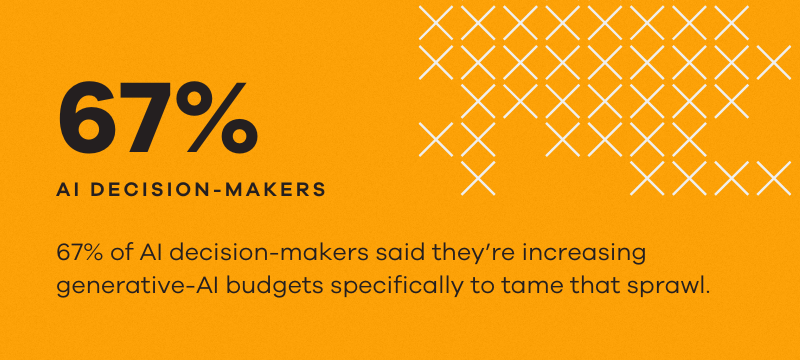
Ask ten knowledge-workers how they spend a typical morning, and you’ll hear the same confession: “I’m still digging for information.” Despite two decades of digital transformation, the average employee loses 5–7 hours a week searching, not finding. In a 2024 Forrester Pulse survey1, 67% of AI decision-makers said they’re increasing generative-AI budgets specifically to tame that sprawl.
Why? Because search has quietly shifted from a lookup tool into the connective tissue for every AI experience that follows. When ChatGPT burst onto the scene, organizations discovered something uncomfortable: Large-language models only become trustworthy when fed by a robust retrieval layer that knows where knowledge lives, who can see it, and how it should be shaped for consumption. In other words, they need a foundation of enterprise-grade search.
Here’s how the evolution of enterprise search is shaping the future of AI…and why investing in this foundation is so critical.
Stage 1
Enterprise Search: When “Findability” Was Enough
In the early 2000s, CIOs raced to deploy “Google for my company.” These platforms crawled file shares, intranets, and document-management systems, applying keyword indexes and security trimming. Employees finally had a single box to type into, but they still had to open each document to tease out meaning.
Yet those first-generation indices laid priceless groundwork:
- Governed metadata: Security models clarified who could see which records.
- Crawling discipline: Teams catalogued where content sat.
Organizations that treated enterprise search as core infrastructure now discover those same indices power their AI ambitions. A leading pharma company recently told us it upgraded none of its repositories; it simply tuned relevancy, enriched metadata, and saw clinical researchers shave weeks off submission prep by reusing approved language.
Pro tip 1: The foundations you lay today, with indexes, taxonomies, and permission trims, determine how far tomorrow’s AI can reach.
Stage 2
AI Search: From Keywords to Questions
Fast-forward. Transformer models and vector databases unlock semantic search: the ability to grasp intent rather than literal strings. Now users can ask, “Who owns the N-acetyl-p-aminophenol patent expiring next year?” and AI search returns a paragraph that cites the PDF line where that expiry date sits.
Three forces fuel this leap:
- Embeddings & vectors: Documents become high-dimensional fingerprints; queries are mapped into the same space.
- Retrieval-augmented generation (RAG): The system fetches top-ranked passages, then passes them to an LLM for summarization with citations.
- Domain-tuned models: Smaller, specialist LLMs cut hallucination risk.
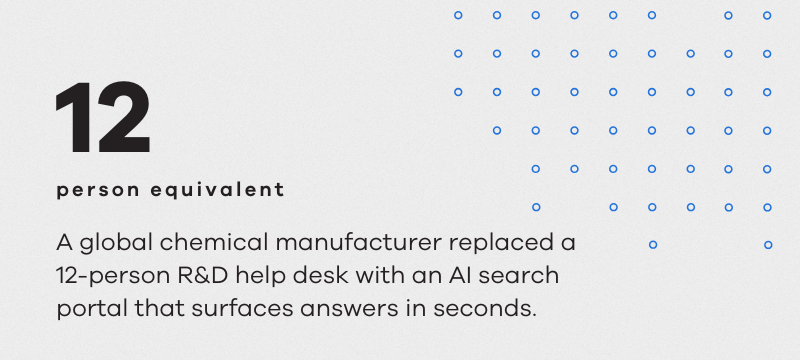
The impact is stark. A global chemical manufacturer replaced a 12-person R&D help desk with an AI search portal that surfaces answers in seconds. Help-desk staff now curate training data and design prompts—higher-value work that still relies on the same search backbone.
Pro tip 2: AI search doesn’t replace enterprise search; it augments it. Without clean, secure retrieval, large-language models are bright students with no textbooks.
Stage 3
Multi-Source Search: The End of “Alt-Tab Archaeology”
Even the smartest search fails if it only sees half the picture. That’s why the next frontier is multi-source search, pulling records from SaaS, on-prem repositories, and bespoke databases into a unified graph. Application connectors handle the heavy lifting of authentication, delta crawling, and permissions.
Consider the average legal firm: knowledge is locked in iManage, Outlook, NetDocuments, SharePoint, and a billing platform of sorts (e.g., Elite or Aderant). Before multi-source search, legal professionals switched screens 30+ times a minute. Now they query once and receive a stitched-together brief that respects ethical walls.
From a data-governance view, multi-source search flips the compliance equation. Instead of copying sensitive material into a new store, it leaves content in place and retrieves it on demand, which is crucial for GDPR, HIPAA, and CJIS requirements.
Pro tip 3: Prioritize connectors with robust change-tracking; stale deltas sabotage AI freshness.
Stage 4
Action Search: When Answers Trigger Workflows
Great—your search bar returns a perfect snippet. Now what? Employees still paste that insight into email or a Jira ticket. Action search closes the gap by exposing tool-calling frameworks inside search results: “Send to PowerPoint,” “Create ServiceNow incident,” “Draft DocuSign envelope.”
Microsoft Copilot plug-ins, Zapier AI Actions, and custom REST calls all serve the same purpose: to collapse the distance between finding and doing. UX matters here. Rather than overwhelm users with buttons, successful teams map the three most common downstream tasks and surface them contextually.
Pro tip 4: Keep it simple. Over-automation breeds mistrust, but guided action invites adoption.
Stage 5
Agentic Search: From Helper to Teammate
Welcome to the horizon. Agentic search marries autonomous agents with world-class search, enabling software that not only answers but acts and keeps acting until a goal is achieved. IBM calls 2025 “the year of the AI agent”2, noting that enterprise developers exploring agentic workflows jumped to 99% in internal polls.
A typical agentic loop looks like this:
- Goal ingestion: “Monitor new ESG regulations and draft a weekly compliance brief.”
- Context retrieval: Enterprise search provides the latest statutes, internal policies, and expert commentary.
- Plan generation: The agent decides to group changes by jurisdiction, map gaps, and assign owners.
- Tool invocation: It files tickets, schedules review meetings, and notifies stakeholders.
- Self-reflection: The agent re-queries search to verify tasks completed, then iterates.
PwC’s May 2025 survey3 of senior executives found 88% plan to raise AI budgets in the next 12 months specifically because of agentic AI, with 79% already piloting agents. Early adopters report not just faster cycles but a measurable difference in outcomes, such as uncovering compliance risks without prompting.

What Makes Agentic Search Possible?
- Trusted enterprise search index – Enforce permission trimming and reduce black-box effect of AI with deeper context.
- Rich Metadata Enrichment – Give agents better input = Better output = More productivity gains
- RAG pipelines & prompt engineering – Supplies domain-specific context windows.
- Observability & guardrails – Captures chain-of-thought, stays compliant, and allows human override.
Agentic Search for Legal: A Day in the Life
Meet Daniel, a senior associate at a global law firm specializing in intellectual property. Historically, Daniel spent hours combing through iManage, SharePoint, and internal knowledge bases to prepare for client matters. By 2026, his firm has fully embraced agentic search—and Daniel’s workday has transformed.
- Retrieves case intelligence. At 6:30 a.m., Daniel’s AI agent runs an automated multi-source search across iManage, NetDocuments, and public case law databases. It compiles a summary of all recent rulings relevant to his client’s patent litigation.
- Drafts a client-ready brief. Using retrieval-augmented generation, the agent drafts a concise, citation-rich overview with embedded source links that Daniel can validate in seconds.
- Detects conflicts and compliance requirements. Before Daniel even opens the document, the agent has already cross-checked ethical walls and flagged a potential related-party conflict. It notifies compliance and proposes an internal resolution path.
- Automates follow-up tasks. The agent pushes a calendar invite to the litigation team for a strategy session, attaches the brief, and creates a matter-specific channel in Teams with relevant documents pinned.
- Proactively monitors new developments. Throughout the week, the agent watches for new docket filings or regulatory updates, automatically updating Daniel’s workspace and alerting him only when critical changes occur.
Instead of burning hours tracking down precedent or worrying about compliance blind spots, Daniel starts his day refining legal arguments and strengthening client relationships. His “search bar” no longer just finds information—it orchestrates his practice.
Implementation Roadmap:
Evolving your own enterprise search can sound daunting, but it’s quite possible and critical with the right processes and technology partner. Here’s a framework for your own approach.
Moving from Stage 1 to Stage 5
- Audit your landscape: Inventory repositories, permissions, and data-quality gaps (metadata tooling is a MAJOR win here).
- Modernize enterprise search: Upgrade relevancy, apply metadata enrichment, and adopt vector indices.
- Connect everything: Deploy application connectors for top-priority systems; the more context, the better.
- Layer AI search: Introduce RAG with small domain models; pilot natural-language answers.
- Surface action search: Expose 2–3 downstream actions where search insight immediately flows.
- Prototype agents: Start with guard-railed, single-objective agents (e.g., weekly digest).
- Govern & measure: Track time-to-insight, action completion, and error rates; iterate.
Pitfalls to Avoid
- Shiny-object syndrome: Skipping foundational search hygiene leads to spectacularly wrong AI answers .
- Siloed pilots: Unconnected proofs of concept create excitement but stall at scale, which is why some experts estimate 90% of AI projects are failing (Everest Group, 2024).
- One-size LLM: A single giant model rarely beats a blend of specialist models plus retrieval.
- Lack of change management: Even perfect answers fail if employees don’t trust or understand them.
- Unrealistic expectations: Looking for the perfect AI solution or platform will end up being a wild goose chase, sinking your precious time and energy investments.
Search Is No Longer a Utility. It’s Strategic Infrastructure.
The humble search bar didn’t disappear. It evolved into the enterprise’s connective brain and digital hands. Agentic Search represents the next era: where information not only answers questions but executes outcomes.
To realize the full promise of AI-enhanced knowledge work, enterprises need technology partners that go beyond simple connectivity to deliver true AI enablement. This means connecting, enriching, and governing data so it can safely power the next generation of agents and copilots. And that is exactly what BA Insight delivers.
BA Insight provides the critical building blocks for this new agentic paradigm:
- A trusted enterprise search index that enforces permissions and delivers deep, contextual relevance.
- Metadata enrichment that optimizes agent accuracy and output through AutoClassifier and intelligent taxonomies.
- Sophisticated RAG pipelines and domain-tuned prompt engineering that ground generative AI in authoritative enterprise knowledge.
- Governance guardrails that maintain compliance, transparency, and security across all connected systems.
By deploying BA Insight’s connectivity platform with embedded AI capabilities, organizations achieve unified, secure, and intelligent access to their enterprise information, turning data sprawl into decision intelligence. The result: measurable productivity gains today and a foundation ready for the future of agentic search.
Cited Sources
1) Forrester (2025) Unlocking Generative AI’s Potential to Drive Growth
2) IBM (2025) AI agents in 2025: Expectations vs. reality
3) PwC (2025 May) PwC’s AI Agent Survey