Why Professional Services Firms Need Real‑Time Visibility to Protect Margins
Why Professional Services Firms Need Real‑Time Visibility to Protect Margins

Professional services leaders do not lose margin because they lack data. They lose margin because the data arrives too late to change the outcome.
By the time a project slips, utilization drops, or client confidence erodes, the financial impact is already underway. That is why real‑time visibility is no longer a reporting nice‑to‑have. It is a core discipline tied directly to margin protection, delivery predictability, and scalable growth.
As AI‑driven expectations rise, services teams are under pressure to forecast accurately, standardize delivery, and surface risk earlier. Yet many firms still operate with delayed, fragmented, low‑confidence data, making critical decisions after the opportunity to intervene has already passed.
That reality is familiar to finance leaders like Joanne Cousins, VP of Finance at Suncorp Valuations, who faced a simple but uncomfortable question before modernizing operations: do I trust this enough to act on it?
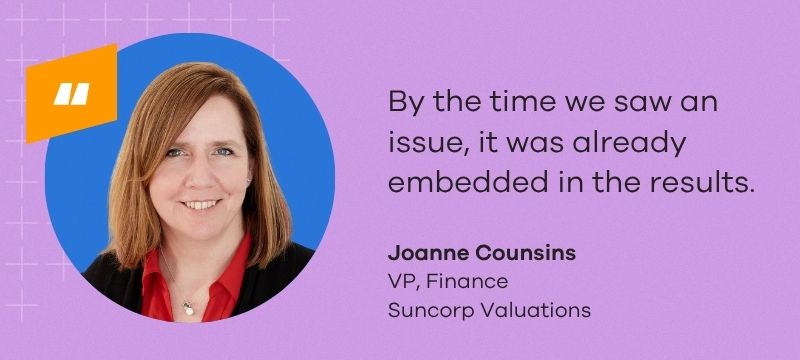
In fixed‑fee, outcome‑driven environments, “mostly” is not good enough. When leaders do not trust the numbers, they cannot intervene early or protect margin before leakage becomes embedded in results.
The cost of delayed visibility
When insight arrives late, teams manage backward. Leadership meetings focus on explaining what already happened instead of deciding what to do next. Forecasts weaken. Delivery risk becomes harder to contain.
Operational teams feel this first as lost control. At the University of Michigan, Vivienne Outlaw, Manager of Data Collection Services, described working with a four‑week gap between activity and insight prior to modernization. Without timely data, teams could not course‑correct fast enough to change outcomes.

Finance experiences the same delay as margin exposure. At Suncorp Valuations, project drift translated directly into absorbed cost. As Joanne explained, by the time issues surfaced, they were already embedded in the results.
This pattern goes well beyond individual organizations. Research from TSIA reinforces that many services firms attempt to modernize on top of inconsistent data and fragmented delivery models. AI does not fix weak foundations; it amplifies them.
Why visibility has become a competitive advantage
Operational visibility is no longer just an internal management issue. It is now part of the client experience.
As Dr. Michael Turner, Global VP of Services and Support at Upland Software, observes, customers increasingly expect immediate insight into progress, risk, and outcomes. Predictability now defines trust and shapes how delivery partners are evaluated.
Renewals and expansions increasingly resemble outcome audits:
- Did delivery match expectations?
- Were risks identified early?
- Could leaders see issues before clients felt them?
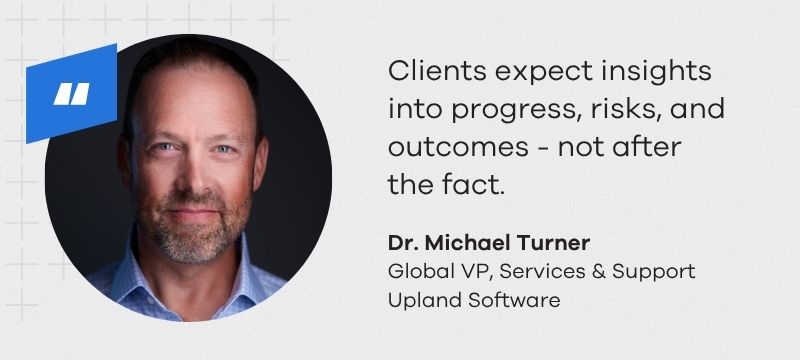
That shift helps explain why visibility now matters strategically. PMI’s recent publication shows that organizations with stronger business acumen consistently deliver better outcomes. Better judgment follows better signals.
Visibility starts with the operating model
Better visibility does not begin with dashboards. It begins with discipline.
From a financial perspective, clarity shows up as governance and accountability. Joanne describes the defining decision as leadership’s commitment to operate transparently once the data revealed the truth.
From an operational lens, visibility only matters if signals drive action. Rafat Hilal, VP of Product Management at Upland Software, highlights a common failure mode: risk signals surface accurately, but without clear ownership embedded in delivery workflows, teams remain reactive.

TSIA describes this progression as “Mastery, then Momentum.” Standardized delivery, integrated data, and disciplined ownership are not preparatory steps. They are the foundation.
Technology enables visibility. Leadership sustains it.
What changes when leaders trust the data
When the operating foundation is solid, leadership behavior changes quickly.
Forecasts become actionable. Meetings move faster. Conversations shift from explanation to intervention.
For Joanne, the shift was walking into leadership conversations without qualifying the numbers. For Vivienne, real‑time data changed the cadence of project management from hindsight to foresight.
Michael summarized, once organizations gain real visibility, they cannot ignore what the data reveals. Expectations rise but so does control.
Three signs your operating model still has a visibility gap
You likely still have a visibility gap if:
- Forecasting conversations begin by debating which report is accurate
- Month‑end close depends on reconciling disconnected systems
- Delivery risk surfaces only after margin, timelines, or client outcomes are already impacted
The gap is not a technology gap. It is a discipline gap.
Upland PSA helps professional services organizations unify delivery, resource, and financial data so leaders can spot risk sooner, improve forecast confidence, and protect margins as they scale.
Ready to see what better visibility looks like in practice? Request a personalized demo to see how Upland PSA helps services teams lead with more confidence.
If you are still evaluating options, browse customer stories and resources to see how organizations like the University of Michigan and Suncorp Valuations improved operational visibility and delivery confidence.
Sources
- Upland Software, How University of Michigan cut administrative staffing effort by nearly 75%
- Upland Software, Suncorp Valuations achieves a 70% faster close with 60% less finance effort
- Upland Software, From Delivery to Outcomes: AI’s New Standard for Service
- TSIA, The Professional Services (PS) 2.0 Transformation: Why AI Success Starts With Getting the Basics Right, January 2026
- TSIA, State of Professional Services 2026 (webinar), January 2026
- TSIA, State of Managed Services 2026: Why Service Is Now the Engine of AI Economics, February 2026
- PMI, Pulse of the Profession 2025: Boosting Business Acumen, 2025