What is Agent Orchestration in AI and Enterprise Search?
Agent orchestration represents a transformative approach in the realm of artificial intelligence (AI) and enterprise search, enabling organizations to streamline workflows and enhance knowledge management.
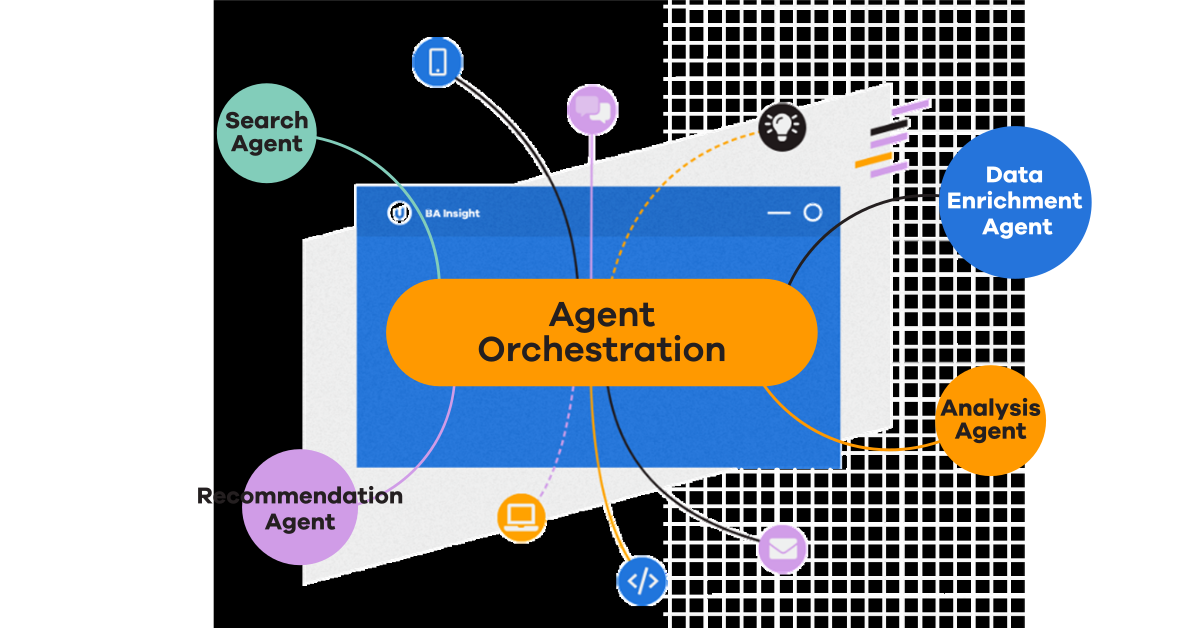
Agent Orchestration: How AI Workflow Automation Enhances Enterprise Data and Search Optimization
Many organizations struggle to get meaningful results from AI because their content and data are fragmented across disconnected systems. Enterprise AI workflows often break down when teams cannot securely connect information, improve data quality, or trust the outputs being generated. Agent orchestration helps address this challenge by coordinating AI agents, systems, and tasks across enterprise data so organizations can automate work more effectively, improve enterprise search, and deliver more reliable outcomes. As businesses invest in AI agents for enterprise search and broader AI enablement initiatives, understanding how agent orchestration supports connectivity, trust, and scale becomes increasingly important.
What is Agent Orchestration in AI and Enterprise Search?
Agent orchestration in AI is the coordinated management of multiple AI agents, tools, and workflows so they can work together across enterprise systems and data sources. In practice, it helps organizations move beyond isolated AI experiments by connecting agents to the right content, information, and business processes at the right time.
For enterprise buyers, this matters because AI success is rarely just about the model. It depends on whether AI can access connected, secure, high-quality data across the business. When agent orchestration is done well, organizations can support enterprise AI workflows that deliver faster access to critical information, reduce manual effort, and improve decision making across teams. Instead of forcing employees to search across silos or validate unreliable outputs, orchestrated AI agents can retrieve relevant information, apply context, and support more accurate next steps.
This is especially important in enterprise search and AI enablement environments, where disconnected repositories, inconsistent metadata, and permissions complexity often slow adoption and reduce trust. By orchestrating AI agents across enterprise systems, organizations can create a more connected and dependable foundation for intelligent search, AI deployment, and workflow automation. That foundation is essential for improving AI outcomes, increasing adoption, and helping AI initiatives move from experimentation to business value.
AI Agent Orchestration Framework for Enterprise Knowledge Work
This paper provides a comprehensive framework for understanding and implementing AI agent orchestration by integrating insights from multiple domains including multi-agent systems, reinforcement learning, and enterprise architecture. It addresses the critical need for robust patterns, protocols, and governance mechanisms to effectively deploy and manage AI agent orchestration in information work, complex decision-making, and automated business processes within enterprise environments. Orchestrating Autonomy: Patterns, Protocols, and Governance for Enterprise Agentic AI, 2025
So, what does this actually mean for your organization? It means agent orchestration is not just a technical architecture choice. It is a practical way to connect enterprise data, improve AI trust, and turn disconnected AI efforts into repeatable business outcomes.
How does agent orchestration coordinate AI agents and workflows?
Agent orchestration improves enterprise search and AI workflows by helping multiple AI agents interact with connected data, business rules, and enterprise systems in a coordinated way. Rather than treating search, retrieval, summarization, and action as separate steps, orchestration links them together into a more efficient process.
This has direct business value. Organizations can give employees faster access to critical information, reduce the time spent manually searching across systems, and support more informed decisions with better context. In enterprise environments, where information is often spread across platforms like Microsoft 365, Salesforce, Jira, Confluence, Google Drive, or document management systems, orchestrating AI agents across enterprise data can improve relevance, reduce friction, and make AI-driven workflows more useful in day-to-day work.
It also helps address common AI adoption barriers. When data is disconnected, poorly structured, or missing context, AI outputs become inconsistent and harder to trust. Agent orchestration works best when paired with strong connectivity, enrichment, and security controls so agents can access the right information, respect permissions, and produce results employees can actually rely on. That is why organizations evaluating AI agents for enterprise search are increasingly focused not only on automation, but also on data quality, secure integration, and trustworthy execution.
Agentic AI Architecture for Enterprise Data & Workflow Coordination
Based on this, we showcase a high-level reference architecture connecting an enterprise data layer (data lake, vector search, knowledge graphs) with an autonomous agent layer with a reasoning and planning layer based on the use of LLM-based paradigms and multi-agent coordination engine to coordinate cross-domain workflows. It describes in the methodology section how to model agent roles and skills, break down business processes into tasks that can be performed by agents, es From Intelligent Automation to Agentic AI: Engineering the Next Generation of Enterprise Systems, VK Yarram, 2024
What roles do AI agents play in automated agent coordination?
AI agents play several critical roles in automated agent coordination, including data processing, decision-making, and task execution. Each agent is designed to perform specific functions, such as retrieving information, analyzing data, or executing commands based on user inputs. For example, a search agent may focus on indexing and retrieving relevant documents, while a recommendation agent analyzes user behavior to suggest personalized content. This division of labor allows organizations to leverage the strengths of each agent, resulting in a more efficient and effective workflow.
How Does Agent Orchestration Improve Enterprise Content and Search?
Agent orchestration significantly enhances enterprise content and search capabilities by enabling seamless integration of diverse data sources and AI technologies. This integration allows organizations to harness the full potential of their data, leading to improved insights and decision-making processes. By orchestrating AI agents, businesses can create a more cohesive data ecosystem that supports better information retrieval and user engagement.
Such enhancements are often facilitated by robust multi-agent architectures designed for dynamic engagement with various enterprise resources.
Multi-Agent Architecture for Enterprise AI Workflow Automation The multi-agent architecture for enterprise AI orchestration enables agents to engage dynamically with external information bases, computational resources, and enterprise systems. This dynamic engagement allows for flexible and adaptive workflow automation, enhancing operational efficiency and data accessibility across the organization. The architecture supports the coordination of specialized AI agents, each contributing to specific tasks within complex enterprise workflows. Multi-Agent Architecture for Enterprise AI Orchestration., 2025
In what ways does AI-driven search optimization benefit from orchestration?
AI-driven search optimization benefits from orchestration by improving the relevance and accuracy of search results. Through the coordinated efforts of multiple agents, organizations can ensure that search queries are processed efficiently, and results are tailored to user needs. For instance, orchestration can facilitate the use of natural language processing (NLP) agents that understand user intent, leading to more precise search outcomes. This optimization not only enhances user satisfaction but also drives higher engagement and productivity.
What examples demonstrate enterprise content orchestration through AI workflows?
Examples of agent orchestration become most compelling when tied to clear business outcomes. In life sciences, orchestrated AI workflows can connect fragmented research and compliance information across systems, giving teams faster access to enriched insights and helping accelerate compliance workflows and scientific discovery. In financial services, orchestrated agents can pull together market data, research, and internal reporting, so analysts spend less time gathering inputs and more time evaluating risk, trends, and opportunities.
A similar pattern applies across enterprise AI environments more broadly. For example, a large accounting firm struggled with an internal AI chatbot that produced misinformation because the underlying data was disconnected, poorly structured, and missing context. By enriching content, improving metadata, and securely connecting enterprise systems, the organization reduced hallucinations, improved answer quality, restored employee trust, and helped teams work faster with more reliable results. This illustrates an important point: successful enterprise AI workflows depend not only on the agents themselves, but on the quality, accessibility, and coordination of the information those agents rely on.
Which AI Orchestration Platforms and Tools Enable Intelligent Agent Management?
Numerous AI orchestration platforms and tools are available to facilitate intelligent agent management, each offering unique features and capabilities. These platforms enable organizations to design, implement, and monitor workflows that involve multiple AI agents, ensuring optimal performance and collaboration.
What features define leading AI orchestration platforms?
Leading AI orchestration platforms typically include features such as workflow automation, real-time monitoring, and integration capabilities with existing enterprise systems. These features allow organizations to create customized workflows that align with their specific business needs. Additionally, many platforms offer user-friendly interfaces that simplify the management of complex workflows, making it easier for teams to collaborate and innovate.
How do orchestration tools integrate with enterprise search systems?
Orchestration tools integrate with enterprise search systems by providing APIs and connectors that facilitate data exchange between different platforms. This integration allows organizations to leverage the strengths of both orchestration and search technologies, resulting in enhanced data retrieval and processing capabilities. For instance, an orchestration tool may connect with a search engine to ensure that the most relevant data is indexed and made accessible to users in real-time.
What Are the Key Components and Semantic Relationships in Agent Orchestration?
Understanding the key components and semantic relationships in agent orchestration is essential for optimizing its implementation. These components include workflows, AI agents, and orchestration platforms, each playing a vital role in the overall system.
How do workflows, agents, and orchestration platforms interrelate?
Workflows, agents, and orchestration platforms interrelate through a structured framework that defines how tasks are executed and managed. Workflows outline the sequence of actions that agents must perform, while orchestration platforms provide the necessary tools to manage these workflows effectively. This interrelation ensures that all components work together harmoniously, leading to improved efficiency and productivity.
What structured data schemas support agent orchestration representation?
Structured data schemas play a crucial role in supporting agent orchestration representation by providing a standardized format for data exchange. These schemas enable agents to understand and interpret data consistently, facilitating seamless communication between different systems. Common schemas used in agent orchestration include JSON-LD and Schema.org, which help define the relationships between various data entities and enhance the overall interoperability of AI systems.
What Emerging Trends and Case Studies Highlight Agent Orchestration in 2025-2026?
As the field of AI continues to evolve, several emerging trends and case studies highlight the growing importance of agent orchestration in various industries. These trends reflect the increasing adoption of AI technologies and the need for efficient workflow management.
Which industries are adopting multi-agent orchestration for AI-driven workflows?
Industries such as healthcare, finance, and retail are increasingly adopting multi-agent orchestration to enhance their AI-driven workflows. In healthcare, for instance, orchestration enables the integration of patient data from various sources, improving care coordination and decision-making. Similarly, in finance, orchestration helps streamline data analysis and reporting processes, allowing organizations to respond quickly to market changes.
What case studies demonstrate measurable benefits of agent orchestration?
Numerous case studies illustrate the measurable benefits of agent orchestration across different sectors. For example, in manufacturing, orchestrated AI workflows can help teams unify product, operational, and technical information across systems so employees can find what they need faster, make better decisions, and keep work moving more efficiently. Such case studies underscore the potential of agent orchestration to drive significant improvements in efficiency and effectiveness within organizations.