From AI Pilot to Production: Building an AI-Ready Data Foundation for Life Sciences
From AI Pilot to Production: Building an AI-Ready Data Foundation for Life Sciences
7 minute read




Top line
Top line
Artificial intelligence is quickly becoming a strategic priority across life sciences. Organizations are investing in AI to accelerate research, improve clinical outcomes, streamline regulatory processes, and help teams make faster, better-informed decisions.
Yet many AI initiatives struggle to move beyond pilot projects.
The challenge isn’t access to AI models. It’s access to trusted enterprise knowledge. When researchers can’t find, trust, or access the information they need, AI can’t deliver faster insights, accelerate discovery, or improve decision-making. AI outcomes are ultimately limited by the quality and accessibility of the knowledge behind them.
Life sciences organizations rely on information distributed across research platforms, clinical systems, document repositories, collaboration tools, and regulatory applications. Much of that content is unstructured, difficult to find, and governed by strict compliance requirements.
Without a connected and trusted data foundation, even the most advanced AI solutions struggle to deliver reliable business outcomes.
As organizations adopt technologies like Amazon OpenSearch Service or Amazon Quick to support generative AI, retrieval-augmented generation (RAG), and intelligent search, the quality of the underlying information becomes increasingly important. Successful AI initiatives depend on the ability to securely connect, enrich, govern, and surface enterprise knowledge at scale.
The AI Readiness Challenge
Many life sciences organizations have successfully launched AI pilots. Fewer have successfully scaled them. As initiatives move from experimentation to production, organizations often discover that model performance alone does not determine success. AI systems are only as effective as the information they can access and trust. In life sciences, where critical decisions rely on research, clinical, regulatory, and quality information, incomplete or poorly governed knowledge can undermine confidence in AI-generated results.
When enterprise knowledge is fragmented across disconnected systems, AI struggles to deliver complete, trustworthy, and explainable results. This creates a gap between AI expectations and business outcomes.
For life sciences organizations, the challenge is even greater. Scientific research, clinical data, regulatory documentation, and operational knowledge often reside in hundreds of specialized systems, each with its own governance and security requirements.
To achieve meaningful results, organizations must first establish a foundation that enables AI to access trusted enterprise information.
Why AI Initiatives Stall
Several common challenges prevent organizations from scaling AI successfully.
Disconnected Systems
Researchers and business users often search across multiple applications to answer a single question. Valuable knowledge remains trapped in departmental systems, creating information silos that limit productivity and slow decision-making.
AI encounters the same challenge. If systems aren’t connected, responses are incomplete.
Unstructured Content
Research reports, SOPs, regulatory submissions, scientific publications, and clinical documentation contain critical institutional knowledge. However, much of this content lacks the metadata and contextual signals needed to support effective AI retrieval.
Without enrichment and classification, answer quality suffers and user trust declines.
Governance and Compliance Requirements
Life sciences organizations operate in highly regulated environments. Compliance requirements, privacy regulations, intellectual property protections, and quality controls must extend into AI experiences.
Users should only see information they are authorized to access, and organizations must maintain confidence that sensitive content remains protected.
Legacy Search Infrastructure
Many existing search environments were designed long before generative AI became a business priority. These systems often struggle to support modern capabilities such as semantic search, vector search, RAG applications, and agent-based experiences.
Search modernization has become a critical part of AI readiness. Modern AI applications depend on the ability to retrieve the right information, apply security controls, and provide relevant context at the moment of need. Organizations that continue to rely on legacy search architectures may find those limitations carried forward into their AI experiences.
Four Requirements for AI Readiness
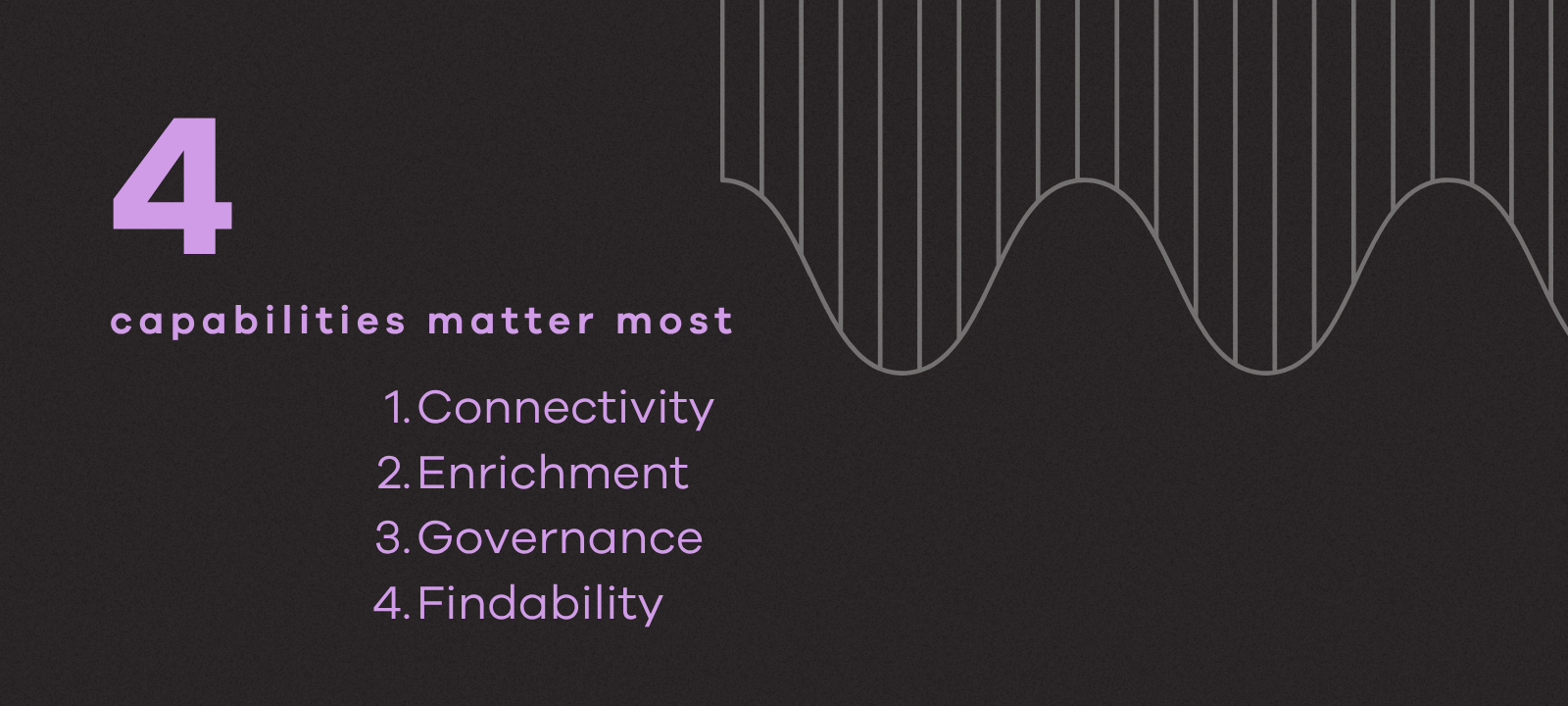
While many organizations focus first on models and copilots, successful AI programs are often built on four foundational capabilities that determine whether AI can scale beyond isolated pilots.
1. Connectivity
Enterprise knowledge must be accessible across critical systems and repositories. This requires securely connecting both structured and unstructured content without disrupting existing business processes.
2. Enrichment
AI performs best when information includes meaningful business context. Metadata enrichment, classification, semantic analysis, and content preparation improve retrieval accuracy and help AI generate more relevant responses.
3. Governance
Security, permissions, and compliance controls must be consistently applied across search and AI experiences. Governance ensures sensitive information remains protected while supporting responsible AI adoption.
4. Findability
Information that cannot be found cannot support AI. Enterprise search enables both employees and AI systems to discover relevant knowledge regardless of where it resides.
Together, these capabilities create a trusted enterprise knowledge foundation that supports search, generative AI, and future AI initiatives.
Why Organizations Choose BA Insight and AWS
AWS provides the scalable intelligent AI platform required to build modern AI solutions. Services such as Amazon OpenSearch Service and Amazon Quick enable organizations to develop intelligent applications that support search, analytics, and generative AI use cases.
BA Insight provides the trusted enterprise knowledge layer that helps maximize the value of AWS AI and search investments. By connecting information across systems, enriching content with business context, and enforcing governance policies, BA Insight helps ensure AI experiences are rooted in trusted organizational knowledge.
By securely connecting content across enterprise repositories, enriching information with business context, and enforcing governance policies throughout the retrieval process, BA Insight helps ensure AI systems operate against trusted organizational knowledge rather than isolated datasets.
Together, BA Insight and AWS help organizations:
- Accelerate research and knowledge discovery
- Improve confidence in AI-generated responses
- Support retrieval-augmented generation with governed enterprise content
- Maintain compliance while expanding AI adoption
- Scale AI initiatives across teams and business functions
- Build a flexible foundation for future AI use cases
From Fragmented Information to AI Readiness
A leading global pharmaceutical organization faced challenges locating information across research systems, clinical repositories, and enterprise content platforms. As information volumes increased, knowledge became harder to find, slowing research workflows and limiting the organization’s ability to support emerging AI initiatives.
Using Amazon OpenSearch Service and BA Insight, the organization unified content across key systems, including Veeva Vault, Documentum, and Amazon S3. The solution created a centralized, secure search experience that enabled researchers to discover information regardless of where it originated.
By connecting previously siloed content while preserving existing security and compliance controls, the organization improved access to critical research and operational knowledge, reduced the time required to locate information across repositories, increased confidence in search results, and established a scalable foundation for future AI and generative AI initiatives.
The outcome reinforces an important lesson: AI success depends not only on powerful models, but on the ability to connect, govern, enrich, and surface trusted enterprise information at scale.
Is Your Data Ready for AI?
Before investing in another AI pilot, consider the foundation supporting it:
- Can you securely connect information across critical systems?
- Do you know where your most valuable knowledge resides?
- Is your content prepared for AI consumption?
- Can you enforce permissions consistently across all search and AI experiences?
- Are your search capabilities ready for modern AI use cases?
If the answer to any of these questions is no, it may be time to evaluate your organization’s AI readiness.
Move Beyond the Pilot Phase
Join BA Insight and AWS for our upcoming webinar, From AI Pilot to Production: A Data Foundation for Life Sciences.
Learn how leading organizations are:
- Building secure, connected data foundations
- Modernizing legacy search environments
- Governing sensitive information at scale
- Supporting trusted generative AI experiences
- Scaling AI initiatives with confidence
AI success depends on more than choosing the right model.
It starts with trusted enterprise knowledge.