What are MCP Servers and What Do They Reveal About Your Data Foundation?
What are MCP Servers and What Do They Reveal About Your Data Foundation?




Enterprise AI has reached a point where the old excuses no longer hold up. For a while, most of the conversation stayed fixed on models. Which one is stronger or cheaper? Which one fits the stack or feels safer for enterprise use? Those questions still matter, but as more organizations move from experimentation into real operational use, a different pattern is becoming harder to ignore.
The most egregious AI failures usually don’t begin with the model. Rather, they’re a result of the surrounding environment.
Answers can sound polished but they miss essential facts. The system pulls from thin, stale, or contradictory source material while sensitive content shows up in the wrong places. Teams lose trust after a few bad experiences, so adoption drops. Leadership starts asking why an AI initiative that looked promising in demos feels fragile in production.
In many cases, the issue isn’t the model at all. It’s the data and content layer feeding it. That’s one reason MCP servers matter right now. Model Context Protocol (MCP) is emerging as a standard way for AI systems to interact with tools, data, and services beyond the model itself.
What is an MCP server?
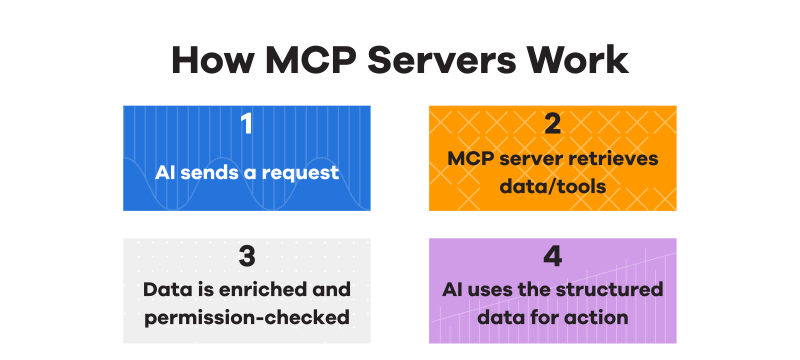
An MCP server provides a standardized interface that allows AI systems to safely access tools, data, and services outside the model. Instead of relying only on a model’s built‑in context or static integrations, MCP enables structured, permission‑aware interaction with enterprise systems.
The business implication is simple: MCP helps AI reach beyond the model itself. It gives assistants and agents a way to access enterprise systems, retrieve information, and potentially take action through a more defined interface.
MCP fits the direction the market is already moving toward: more agentic workflows, more tool use, more orchestration, and more enterprise expectations around usefulness.
But this is also where the confusion tends to creep in. Once people hear “MCP server,” they often assume it is just another word for a connector.
Let’s correct that misconception.
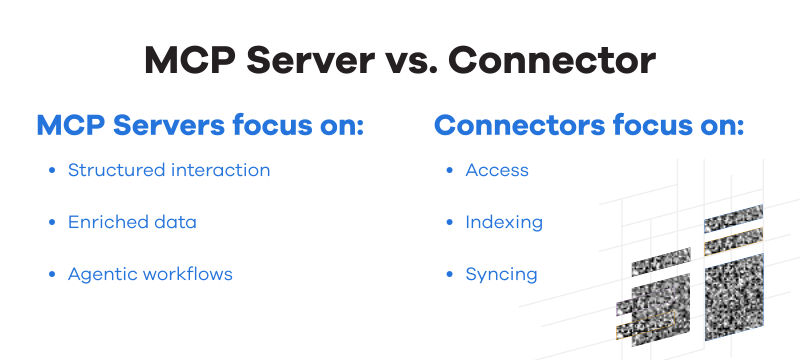
A connector and an MCP server may both help AI reach external systems, but they do different jobs. A basic connector focuses on access. It moves content or exposes a path between systems. In enterprise environments, that often means indexing or syncing data from repositories so it can be searched, retrieved, or used elsewhere. BA Insight’s own positioning reflects this clearly: connectivity is necessary, but it’s only one part of the larger AI-enablement problem. The bigger value comes from secure access, enrichment, context, and preparation of data for AI consumption.
An MCP server, by contrast, is more about structured interaction. It can provide a model with access to tools, functions, or information in a way that is usable inside an agentic workflow. It’s not just helping content move, but is helping a model do something with a reachable system.
That’s a critical distinction, because once AI moves from “answer a question” to “retrieve, reason, summarize, decide, and act,” the standard for infrastructure changes. Suddenly, it isn’t enough to say the data is technically reachable. Now you have to ask:
- Is it the right data?
- Is it current?
- Is it permission-aware?
- Is it enriched enough to be interpreted correctly?
- Is it being surfaced with the business context that gives it meaning?
A connector may help create access. An MCP server raises the expectation that the access will actually support intelligent work. That’s where many enterprises get exposed.
Recognize that MCP does not create foundation problems. It reveals them.
MCP servers are showing up at the same moment enterprises are trying to make AI more useful inside real workflows. That means the model is no longer operating in a carefully curated sandbox. It’s being asked to reach into the messier reality of enterprise information. And we can all admit that enterprise data is rarely neat.
It lives across file shares, collaboration tools, document repositories, CRMs, intranets, service systems, research platforms, and line-of-business applications. Metadata is uneven. Naming conventions drift over time. Duplicate content accumulates. Permissions vary across systems. Some material is current and authoritative; some is outdated but still easy to retrieve. Some systems are deeply valuable but hard to access cleanly. Others are easy to connect but low in signal.
When AI gains broader access through richer retrieval and agentic patterns, all of that starts to matter more.
That’s why weak data foundations have mostly produced friction. Employees spent too much time searching and teams duplicated work. People relied on tribal knowledge or simply asked coworkers instead of trusting the system. It was expensive, but survivable.
But in the current AI environment, the same weaknesses no longer just slow work down. They influence what the model sees, what it retrieves, what it prioritizes, what it summarizes, and sometimes what it does next. That’s a very different level of risk.
Why this matters now
The rise of agentic AI has changed the stakes on all fronts. Search used to sit quietly in the background as a support capability, helping users find documents, pages, or people. Now retrieval is becoming part of the operating logic of AI. It shapes reasoning, response quality, workflow execution, and trust. That shift is why infrastructure questions suddenly feel urgent again.
AI projects fail when organizations ignore the quality, structure, connection, and security of the content feeding the system. It goes beyond just “connecting more data.” Instead, that information must be connected securely, enriched with context, and made usable for AI at scale.
That’s also why the market is starting to realize that access alone is not enough.
An enterprise may say:
- “We have integrations.”
- “We have APIs.”
- “We have a few connectors.”
- “We can wire our assistant into key systems.”
But those statements don’t answer the harder questions.
- Can the system distinguish current guidance from outdated material?
- Can it preserve item-level access controls across repositories?
- Can it understand what a document means in context, not just that it contains matching words?
- Can it retrieve information consistently across messy content environments?
- Can it support trust once real users start putting pressure on it?
Those aren’t edge questions anymore.
The problem usually starts below the interface
One reason AI rollouts disappoint people so quickly is that the interface often looks more mature than the foundation beneath it. Underneath that surface, the system may still be relying on disconnected repositories, weak metadata, broad permission assumptions, duplicate files, and content that was never prepared for machine retrieval in the first place.
That gap creates predictable outcomes:
- Answers that sound convincing until someone checks the source
- Retrieval that mixes stale and current material
- Inconsistent responses to similar questions
- Security concerns that slow expansion
- Low trust once users encounter a few high-visibility misses
When an MCP-enabled environment underperforms, the problem may not be that MCP failed. It may be that MCP exposed the real condition of the enterprise information layer.
What MCP servers force enterprises to confront
Once organizations start thinking seriously about MCP servers, they are usually moving into a bigger ambition for AI. They want assistants and agents that are more useful, more contextual, and more operationally embedded. That ambition is valid, but it forces a more honest look at the foundation.
MCP tends to surface questions like:
What data can the model actually reach? |
Is it connected only to the easiest systems, or to the systems people genuinely rely on? |
What shape is that content in? |
Is it enriched, structured, and understandable to machines, or is the model being asked to sort through disorder on its own? |
Does context travel with the content?
|
Can the system tell what is authoritative, who should see it, and how it relates to adjacent business intelligence? |
Do permissions hold at the item level? |
Or does the environment depend on simplifying assumptions that become risky at scale? |
Would the system hold up outside demo? |
Or is it only reliable under curated conditions? |
More than merely theoretical concerns, these sit right at the center of enterprise AI readiness.
The real opportunity
MCP servers matter because they represent a more serious phase of enterprise AI. They help move the market beyond one-off prompts and toward systems that can retrieve, coordinate, and support meaningful work. That’s useful progress, but their deeper value may be diagnostic. They expose whether the organization has done the less glamorous work required to support AI at scale:
- Secure connectivity
- Clean metadata
- Prepared content
- Source integrity
- Permission-aware access
- Coherent retrieval across systems
The enterprises that look more ready for this moment didn’t get there by accident. They treated information infrastructure as a strategic investment long before the current buzz around agents and protocols. They worked on search, structure, permissions, and content quality early (or at least earlier than most).
The ones struggling now are often trying to build more advanced AI behaviors on top of unfinished data foundations. MCP did not create that gap; it just made the gap harder to hide.
5 questions to ask before calling your environment AI-ready
Before your team adds another layer of copilots, agents, orchestration, or MCP-based tooling, stop and ask:
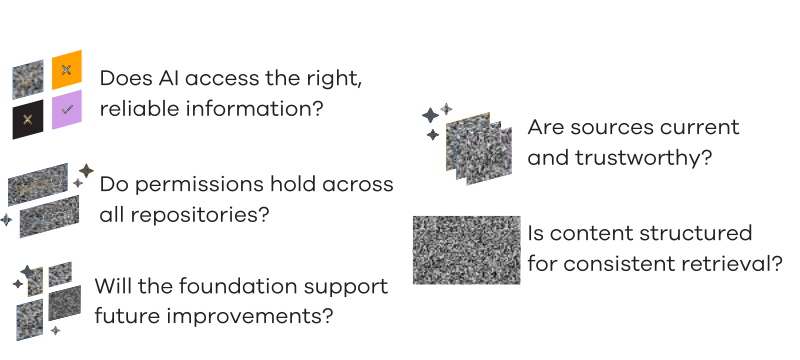
- Does your AI environment reach the information your people rely on every day, or only the content easiest to connect?
- When the system returns an answer, do users know which sources shaped it and whether those sources were current and authoritative?
- Do permissions hold at the content level across repositories, or does your setup depend on broad access assumptions?
- Is your content structured and enriched well enough for machine retrieval to stay consistent?
- If the interface got better tomorrow, would the foundation underneath it still hold up?
While these are simple questions, they are also uncomfortable ones.
Bringing the positive out of the negative
MCP servers are worth paying attention to, not because they magically solve enterprise AI, but because they make enterprise AI more operationally real. And as soon as AI becomes more operationally real, infrastructure matters more.
That’s the bigger lesson here. In enterprise environments, usefulness does not come from model access alone. It comes from what sits underneath: connected systems, secure retrieval, structured data, preserved permissions, and content that is actually ready to support AI.
More than just a new technical abstraction, MCP servers are a pressure test for the data foundation you already have. For many enterprises, that test is going to be revealing.
Want to talk MCP servers, knowledge graphs or anything else enterprise AI enablement or search related?