MCP Standardizes Connectivity—But It Exposes What Enterprises Never Fixed
MCP Standardizes Connectivity—But It Exposes What Enterprises Never Fixed
9 minute read




In Part 1 of this series, we explored how the Model Context Protocol (MCP) is beginning to standardize the way AI systems connect to enterprise tools, repositories, and workflows. That shift matters, not because connectivity was impossible before, but because it was inconsistent and difficult to scale.
MCP removes that variability. It makes connectivity predictable.
But standardizing how systems connect does something else entirely: It exposes the condition of what they’re connecting to.
For years, enterprise leaders have treated AI primarily as a model decision. Which model is strongest? Which is safest? Which fits the stack? Which justifies the spend?
Those are important questions. Yet as AI moves out of pilots and into daily work, a more revealing pattern is starting to emerge:
The biggest failures usually are not model failures.
They are data failures.
MCP helps solve how systems connect. What organizations are discovering now is that the quality, structure, and context of what gets connected has become the real constraint.
That’s a critical distinction because enterprise AI is no longer just generating text in a controlled environment. It’s being asked to retrieve information, reason across systems, summarize documents, support decisions, and increasingly operate directly inside workflows. In some cases, it’s being asked to take action.
The moment it starts working against real enterprise information, it runs into the same problems employees have dealt with for years:
- Fragmented systems
- Weak metadata
- Unclear sources of truth
- Stale content
- Mismanaged permissions
That’s why some organizations look more prepared for the AI era than others. They did not get there by accident. They spent years building the data foundation today’s AI systems depend on.
What MCP is revealing is that enterprise connectivity was never the full problem. Readiness was.
And that readiness gap was created across multiple phases of enterprise data maturity.
Phase 1: Indexing Without Context
The first phase of enterprise data maturity addressed a basic but urgent problem: information was multiplying rapidly and spreading across disconnected systems, with little consistency in how it was organized or accessed.
Content lived across file shares, intranets, portals, document management systems, databases, line-of-business applications, and team sites. Employees needed a way to find documents without already knowing where they lived.
Early indexing and retrieval systems changed that.
It gave organizations a way to index content and retrieve it through terms, metadata, and fields. For many enterprises, this was a meaningful leap forward. Instead of relying entirely on folder structures, email chains, or institutional memory, people could search across a much broader universe of information.
But the limitations became obvious almost immediately. Keyword search works best when users already know what to ask for, but enterprise work rarely operates that cleanly. Employees inherit unfamiliar projects and collaborate across teams that use entirely different terminology.
These early systems could identify where a term appeared. What it could not reliably determine was whether the content was current, authoritative, or even the right answer.
MCP now makes these disconnected systems easier for AI to access.
But this did not solve understanding.
As enterprise environments became more complex and content volumes exploded, that gap became increasingly difficult to ignore.
Phase 2: Interpretation Without Trust
The next phase attempted to make retrieval less literal. It improved retrieval by moving beyond exact keyword matching. Search systems became better at synonym expansion, natural language interpretation, related meaning, and similarity across content.
Retrieval systems started feeling less like a rigid string match and more like a system attempting to interpret intent.
Users no longer had to guess the exact phrasing a document author used years earlier. Search became more forgiving. It became easier to locate relevant material even when the query language did not perfectly match the source content.
Still, semantic search had its own ceiling, since understanding language is not the same as understanding business context.
A system may recognize related concepts while still failing to understand which source is authoritative, whether a document is outdated, or which content applies only to a specific region, customer, matter, or team.
This is where many enterprises mistook progress for completion. MCP accelerates interoperability between systems and models. And while these advances improved interpretation, they did not solve source integrity, governance, content quality, or trust.
Employees could often find more information. But they still could not always trust what they found.
Phase 3: Connectivity Without Readiness
The third phase focused on unification. Organizations recognized that information fragmentation itself had become a productivity problem. Information was trapped inside specialized systems that did not communicate with one another.
Enterprise data access layers evolved to connect repositories across the organization into a unified access layer across enterprise data.
This was a major step forward in connecting enterprise data, but not in preparing it for reliable use. For the first time, organizations could create a unified layer across enterprise data instead of forcing employees to manually navigate disconnected applications.
But many enterprises stopped short by connecting systems without fully preparing the information inside them.
Content remained duplicated, inconsistently classified, poorly labeled, or missing meaningful metadata. Taxonomies drifted across departments. Permissions became difficult to govern consistently at scale.
Large amounts of enterprise data stayed trapped inside repositories that were technically connected, but not consistently structured, governed, or reliable enough for AI systems—or employees—to interpret with confidence.
In earlier phases, these weaknesses mostly created friction as employees lost time while searching for information and manually verifying answers. They relied on tribal knowledge to determine what was trustworthy.
In the AI era, those same weaknesses become operational liabilities. As MCP and similar frameworks remove barriers to connectivity, connected does not mean AI-ready.
That distinction is becoming impossible to ignore.
Phase 4: Agentic AI Exposes the Foundation Underneath Everything
Phase 4 changes the equation entirely. As connectivity becomes increasingly standardized through frameworks like MCP, organizations are removing barriers between AI systems and enterprise data faster than ever before.
For the first time, AI systems are no longer constrained by integration complexity. This is the shift MCP is now forcing enterprises to confront.
The question now is whether the underlying data can support reliable retrieval, reasoning, and action once they do. That acceleration is significant, and it exposes something many enterprises underestimated. MCP solves an important infrastructure problem by standardizing how AI systems connect to enterprise tools and repositories.
But standardized access is not the same thing as operational readiness.
The conversation shifts from:
“Can AI access our data?”
To:
“Is our data actually ready for AI to use responsibly?”
That’s where the market is now. In the agentic era, the same weaknesses carry far more weight.
AI is no longer sitting off to the side as a passive assistant. It’s increasingly embedded directly into workflows, recommendations, approvals, research, drafting, analysis, and operational execution.
Consider the stakes raised. Considerably.
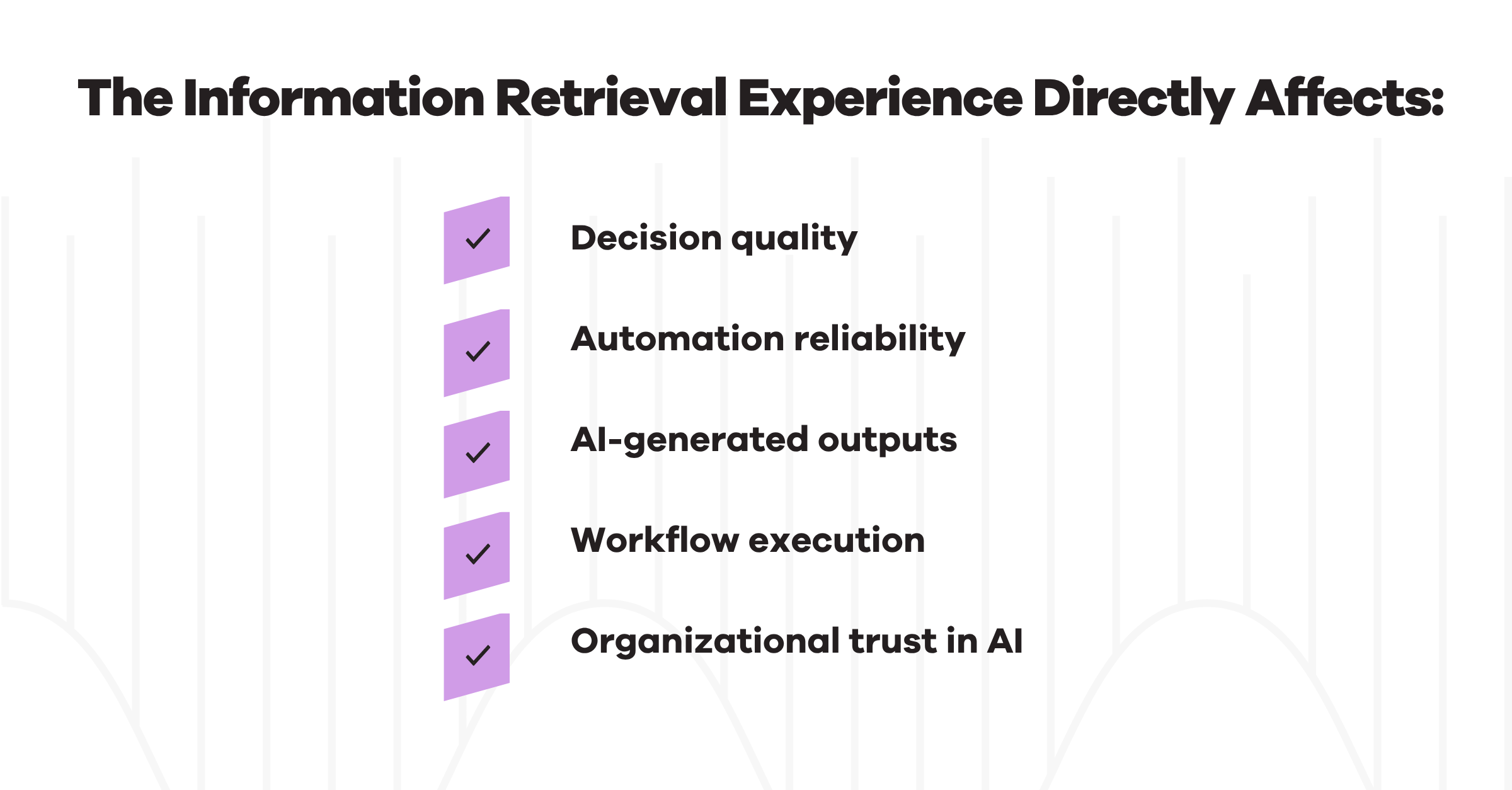
When retrieval is weak, context is incomplete, permissions are inconsistent, or source quality is poor, the problem no longer ends with a frustrating information retrieval experience. It directly affects:
- Decision quality
- Automation reliability
- AI-generated outputs
- Workflow execution
- Organizational trust in AI itself
MCP may standardize connectivity, but it is simultaneously exposing which enterprises are truly ready for AI—and which never fixed the underlying condition of their data foundations.
AI is Revealing the State of Enterprise Information
The more useful question for leadership teams is no longer:
“Which AI model should we choose?”
It is:
“What kind of data foundation does AI reveal we actually have?”
That reframing forces organizations to confront issues that were easier to postpone during earlier waves of search modernization and digital transformation.
Questions like:
- Can AI reliably identify the most authoritative version of our information?
- Do our systems preserve permissions and security consistently across repositories?
- Is our enterprise content nriched with enough metadata, structure, and context to support retrieval, reasoning, and automation?
- Can employees — and now AI agents — trust the outputs being generated?
These are essential operational AI questions. This is also why organizations are discovering that AI success depends far less on model selection than many initially assumed.
Most modern AI models are increasingly capable. The differentiator is the quality of the enterprise data environment surrounding them.
Organizations with fragmented, inconsistent, poorly governed information foundations are finding that even advanced models struggle to produce reliable results.
Meanwhile, organizations that invested early in findability, metadata, governance, enrichment, and secure connectivity are moving faster because their content environments are easier for AI systems to interpret and operationalize.
Why AI Readiness Now Depends on Data Readiness
Consider the changing role of the enterprise data access layer within organizations. What once served primarily as a way for employees to locate documents is now becoming part of the operational infrastructure behind enterprise AI.
This shift explains why the line between data strategy and AI strategy is collapsing. Organizations that still treat them as separate initiatives will feel increasing pressure as agentic use cases expand.
The companies succeeding here are investing in making their knowledge infrastructure AI-ready by enriching content, improving metadata, preserving security context, reducing duplication, and ensuring information can be trusted before it reaches AI workflows.
The future advantage of AI enablement will not come from access alone. It will come from the ability to prepare, structure, govern, and operationalize enterprise content for AI systems at scale.
That includes:
- Secure connectivity across repositories
- Metadata enrichment and classification
- Permission-aware retrieval
- Content preparation for retrieval and reasoning
- Governance that preserves trust and compliance
Organizations that treat these as foundational capabilities rather than mere cleanup projects will move faster as AI becomes more deeply embedded into enterprise operations.
The Real AI Divide
MCP is accelerating this shift by removing one of the final barriers—how systems connect. What remains is far more difficult to address: the condition of enterprise data itself.
As a result, AI is now forcing enterprises to confront a reality that has existed for years:
Most organizations do not have a model problem.
They have a knowledge problem.
The companies that move fastest in the next phase of AI adoption will not necessarily be the ones experimenting with the most models. Instead, they’ll be the ones building trustworthy, connected, permission-aware, AI-ready data foundations underneath them.
That starts with a few critical priorities:
- Evaluating whether enterprise content is truly usable by AI systems
- Identifying gaps in metadata, governance, security, and source quality
- Reducing fragmentation across repositories and workflows
- Preparing information for retrieval, reasoning, and agentic execution, not just storage
MCP may standardize how systems connect. But the organizations that realize long-term value will be the ones that ensure what MCP connects to is structured, governed, and ready for AI to use.