Email Marketing in 2026: The Trends That Will Shape the Game
Email Marketing in 2026: The Trends That Will Shape the Game

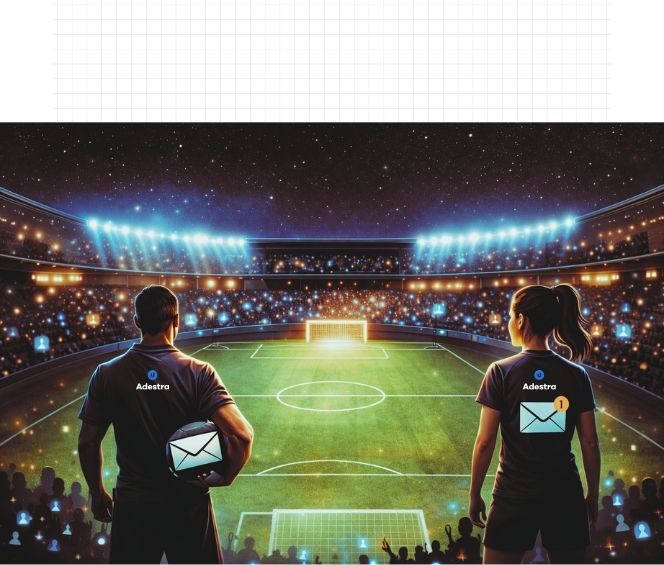
If 2025 felt like playing football in someone else’s back garden – goalposts moving, new rules enforced mid‑match, and the ball suddenly being taken away – you weren’t imagining it. Inbox providers, like Gmail, Microsoft and Apple, tightened compliance, AI changed how audiences discover content, and publishers and marketers learned (again) that relationships beat algorithms.
We said all of this in our Upland Adestra Marketing Year‑in‑Review 2025 – and it set the stage for what’s coming next.
Table of Contents
- Email Marketing Trends in 2026
- The Intelligent Inbox Will Prioritize Your Emails
- Email Will Strengthen its Position Your Omnichannel Journey
- Authentication & Trust Become Non-Negotiable
- Interactive Content and Zero‑Party Data Go Hand‑in‑Hand
- The KPIs That Matter Will Shift – Again
- The Human Element: Why People Matter More Than Ever
- Stay in the (In)Box
- Future Proof Your Email Marketing Strategy
Email Marketing Trends in 2026
Spoiler Alert: 2026 won’t be “more of the same.” The marketing landscape will move faster than most of us can imagine. Therefore, it would be incredibly naïve to pretend there’s a guaranteed roadmap that will carry us all smoothly through the next 12 months.
What we can say with confidence is this: the line between “sent” and “seen” will only get sharper as intelligent inboxes, predictive AI, and trust signals separate the grown‑ups from the dabblers.
With the caveat that email marketers will have to be more agile than ever (and we’ll keep you up to date in this blog over the course of the year), here’s how we see the email marketing landscape changing in 2026:
The Intelligent Inbox Will Prioritize Your Emails
It’s been a long time since email could be referred to as a “dumb” marketing channel. In fact, it’s the growing intelligence of the inbox environment, initially protecting us from spammers, phishing scams, and other security threats, that has made email such a resilient, engaging, and profitable channel. And the inbox is getting smarter.
Inbox providers no longer solely rely on traditional signals like domain reputation or historical engagement. Instead, they’re drawing on real‑time behavioral indicators – scroll depth, how quickly a message is deleted, whether a user replies, and even how often recipients let your emails linger unopened to decide what deserves premium placement and what gets quietly deprioritized.
While this might appear to be a very modern way of prioritizing emails, many of the best practices that will keep you on the right side of the inbox visibility should be remarkably familiar.
With this in mind, we’ve outlined 12 essential best practices that will help inbox providers prioritize your campaigns – so your emails stay visible, relevant, and trusted in the age of the intelligent inbox.
12 Steps to Being Seen in the Intelligent Inbox
- Earn attention with every send: If your emails don’t drive meaningful engagement, intelligent inboxes will quietly deprioritize them. Attention is no longer assumed – it has to be earned, every single time you hit send.
- Create genuinely useful content: The intelligent inbox looks beyond clicks, factoring in signals like scroll depth and dwell time to assess value. Clickbait and gimmicks might win a moment – but they won’t fool a behavioral model.
- Think in terms of sessions, not sends: Inbox algorithms reward content that holds attention and encourages continuation, not campaigns that simply land and disappear.
- Be ruthless with list hygiene: Inactive subscribers dilute your performance signals. Retire them, re‑permission them, or risk dragging down the behavioural profile of your entire program.
- Optimize for micro‑engagement: Scrolls, taps, pauses, and time spent reading now matter more than opens ever did. These small signals quietly shape how inboxes decide who sees what.
- Avoid batch‑and‑blast behaviour:
High deletion rates are poison to inbox placement. If large segments consistently skim and bin your emails, inboxes learn quickly – and respond accordingly. - Segment by behavior, not assumptions: If inbox providers prioritise behavioral signals, your strategy should too. What subscribers actually do matters far more than what we think they want.
- Refresh your creative regularly: Predictable templates encourage skim‑and‑bin behavior. Variability in layout, format, and presentation keeps attention – and curiosity – alive.
- Use subject lines and previews to set honest expectations:
Deletions without opens send powerful negative signals. The promise on the outside must genuinely reflect the value inside. - Encourage replies when appropriate:
Email is a two-way communication channel. As such, replies remain one of the strongest indicators of real, human relevance – something intelligent inboxes still value deeply. - Deliver value quickly: Lead with what matters most. If subscribers have to search for relevance, the inbox will assume it isn’t there.
- Automate around behavior: Triggered, context‑aware emails naturally generate stronger engagement signals – because they arrive when subscribers are most likely to care.
The Intelligent Inbox: Questions You Need to Ask Before Every Send
Not every signal the intelligent inbox cares about is easily measurable. While scroll depth can be inferred through tools like heatmaps, metrics such as dwell time and deletions are far harder to see directly. This is where good, old‑fashioned common sense still matters.
Before every send, you should ask yourself a few simple but critical questions: Does this email genuinely deliver value to the subscriber? Do the subject line and the content align clearly, without surprises or bait‑and‑switch tactics? And once the email lands, what are you actually encouraging the reader to do – after they receive it, open it, and engage with it?
Intelligent inboxes may be powered by algorithms, but they still reward emails that feel purposeful, relevant, and respectful of the subscriber’s time.
Email Will Strengthen its Position in Your Omnichannel Journey
As search visibility becomes increasingly unpredictable (some would say that it has already fallen off a cliff thanks to phenomena like Google Zero – which has seen some publishers report a loss of upwards of 80% of their search traffic) and social channels continue to fracture into smaller, algorithm‑controlled pockets, brands are rediscovering something essential: email is the one channel they truly own. In 2026, that ownership becomes a strategic advantage.
It has been a long time since most of us considered email as a broadcast tool. In more recent times, it’s evolution into the orchestration layer for the entire customer experience has accelerated. Instead of thinking in terms of isolated campaigns (“send an email,” “run an SMS blast,” “update website”), leading brands are designing journeys where email acts as the connective tissue linking every touchpoint. It sits at the centre of a coordinated ecosystem, working seamlessly with:
- CRM data: Where organisations completely utilize their first party customer data to shape, define and execute their messaging. Those with limited data-inventories are creating initiatives to acquire it.
- SMS: For timely nudges, confirmations, and rapid engagement moments that complement – not compete with – email.
- Web personalization: Where email click‑behavior triggers dynamic onsite experiences tailored to the individual.
- eCommerce events: Where browse abandonment, cart activity, replenishment cycles, and loyalty milestones automatically feed back into email automation.
This is no longer about channel selection. It’s about journey design. This means that savvy marketers are mapping the exact moments where a subscriber should receive an email, when an SMS makes more sense, and when a personalized website experience should carry the baton. The magic lies in the handoffs – ensuring that every message, on every channel, feels like part of a single, coherent conversation rather than a disconnected series of touchpoints.
In 2026, the brands that win won’t be the ones shouting the loudest. They’ll be the ones orchestrating the most seamless, elegant, and personalized cross‑channel experiences – with email as the backbone, ensuring every step feels intentional, relevant, and human.
Authentication & Trust Become Non‑Negotiable
If 2024 was the warning shot and 2025 was the recalibration, then 2026 is the year inbox trust becomes an absolute requirement. Gmail’s recent compliance clampdown signaled a permanent shift: inbox providers are no longer politely suggesting best practices – they’re actively enforcing them with real consequences.
Essentially, those good old inbox filters have evolved far beyond a simple checkpoint for spam. They now assess sender identity, domain alignment, message integrity, and visual trust cues before a single line of your content is even considered. This is where authentication frameworks – SPF, DKIM, DMARC, and BIMI – come into play. In 2026, these frameworks are no longer part of a “deliverability optimization program” – they’re the minimum entry requirement for visibility.
Interactive Content and Zero‑Party Data Go Hand‑in‑Hand
Interactive content doesn’t just look good – it powers smarter segmentation, strengthens engagement signals, and future‑proofs your entire email strategy.
In 2026, subscribers expect online experiences that are interactive, useful, and genuinely personalized. Quizzes, polls, product selectors, rating modules, and even lightweight gamification (our colleagues at Upland Second Street have this down to a fine art) are rapidly becoming standard elements in modern campaigns.
But here’s the real shift: interactivity isn’t just engagement theatre anymore. In email, it becomes one of the most powerful – and most compliant – ways to collect zero‑party data.
What is Zero-Party Data?
Zero‑party data is pure gold for email marketers. Where as first-party data is derived from observed actions (website visits, purchases, etc.), zero-party data is taken from the information subscribers willingly and intentionally share: their preferences, interests, motivations, timing, and purchase intent. No cookies. No surveillance. No hidden tracking. And as privacy expectations tighten and intelligent inboxes increasingly reward meaningful engagement, this kind of self‑declared data becomes the backbone of reliable, human‑centered personalization.
The KPIs That Matter Will Shift – Again
Suggesting that open rates are now largely unreliable is pretty much old news now. The real question is: how reliable are the other metrics we still depend on to judge success? Bot clicks have made that question impossible to ignore. And in 2026, the industry will push harder than ever toward KPIs that reflect genuine human engagement – not automated noise.
The Rise of Bot Clicks
Security filters and corporate firewalls increasingly pre‑scan emails, clicking links automatically to test for malicious destinations. These bot clicks create artificial spikes in click‑through metrics (with estimates ranging from 20% to 60% of clicks), making it harder to judge who actually engaged and who simply tripped an automated security process.
For marketers, this means vanity metrics don’t just mislead – they can actively distort automation triggers, personalization logic, A/B testing results, and the signals inbox providers use to determine whether your messages deserve to be seen. Because of this, 2026 will place greater emphasis on KPIs rooted in human intent, not automated noise.
Expect to lean into metrics that more accurately capture genuine engagement, including:
- Click‑intent and meaningful interactions: Not every click is equal – and in the age of bot pre‑scans, some clicks aren’t human at all. Marketers will increasingly filter for behaviors that only real people exhibit: slower click patterns, depth of engagement, onsite dwell time, scroll activity, follow‑on behavior, and downstream conversions.
- Conversion quality over conversion volume: A spike in clicks means nothing if it doesn’t translate into actions that matter. Revenue‑generating behavior – purchases, upgrades, sign‑ups, responses- is now the clearest indicator of true audience engagement.
- Subscriber lifetime value (LTV): Inconsistent metrics require stable anchors. LTV helps marketers prioritise the subscribers who stay, buy, and meaningfully interact over time.
- Inbox placement health: As inboxes get smarter, placement becomes a KPI in its own right. If real humans aren’t engaging – and bots are inflating the numbers – your visibility will decline.
- Opt‑in and opt‑out patterns: Subscription behavior is one of the few unequivocally human signals left. Steady gains in high‑intent opt‑ins and reductions in friction‑based churn tell you more about audience alignment than any bot‑inflated click rate ever could.
In 2026, the question won’t’ be “What was the click‑through rate?” It’ should be “Was this a human action, and does it reflect real intent?”
The Human Element: Why People Matter More Than Ever
With AI taking on more of the operational weight, it’s easy to assume the marketer’s role gets smaller. In reality, the opposite is true. Email marketing in 2026 will be defined not by how much automation you deploy, but by how intentionally humans guide it.
AI can process patterns, but it can’t understand people. It can predict behaviors, but it can’t empathize. It can generate messages, but it can’t feel the emotional context that makes a message matter. And while intelligent inboxes reward relevance, only humans can define what relevance truly looks like.
In a year where deep behavioral modelling, zero‑party data, and omnichannel orchestration will shape the customer experience, people sit at the center of it all:
- People decide the strategy: The narrative, and the value you want to deliver.
- People set the ethical lines: Ensuring data is used responsibly and transparently.
- People craft the brand voice: Setting the emotional tone, and the creative nuance AI can’t replicate.
- People listen to customers: Interpreting what they’re really saying, and closing the gaps machines can’t see.
- People build relationships: The one factor every inbox algorithm ultimately rewards.
AI can and will help you get more done, do it faster, and make smarter decisions. But it’s your team – the marketers, creators, strategists, analysts, CRM specialists, and customer‑facing humans – who give those decisions purpose.
Stay in the (In)Box
While email marketing’s “goalposts” might be moving, and defensive plays more brutal, in 2026 the smart marketers will keep their eye on the ball and constantly be ready to attack the inbox with a strategy that ensures more of their sends are on target and deliver positive results.
The brands that win this year won’t be the ones with the most automation; they’ll be the ones who use AI to free their people to do what they do best: think, create, empathise, listen, and build experiences that feel unmistakably human. Because at the end of the day, inboxes may be getting smarter – but people are still the ones you’re talking to.
Future-Proof Your Email Strategy
If you’re ready to future‑proof your email strategy – and take control of the game and score more – by giving your team the tools to create more human, high‑impact customer experiences – let’s talk. Contact the email marketing experts today at Upland Adestra and see how we can help you own the inbox in 2026 and beyond.
Get the latest insights right in your inbox
Sign-up for our monthly newsletter for the latest email marketing news and best practices. No spam, just actionable insights that will see you into 2026 and beyond.