Unlocking ROI: 4 Use Cases for AI-Powered Knowledge Management
Unlocking ROI: 4 Use Cases for AI-Powered Knowledge Management

AI has proven its worth across industries, but when it’s time to get budget approved or justify a new initiative, hype won’t help. Leadership wants cold, hard numbers. Think: cost savings, time saved, faster resolutions, fewer escalations, and better customer experience (CX).
That’s why return on investment (ROI) conversations work best when you start with a specific situation.
“Knowledge management,” or KM, can sound like a black hole. We get it; it’s abstract. But a service desk overloaded with escalations, a contact center stuck with long handle times (HT), or a self-service site that does not actually reduce tickets is very real. When you connect those situations to the right metrics, ROI becomes a lot clearer. And, a lot easier to defend.
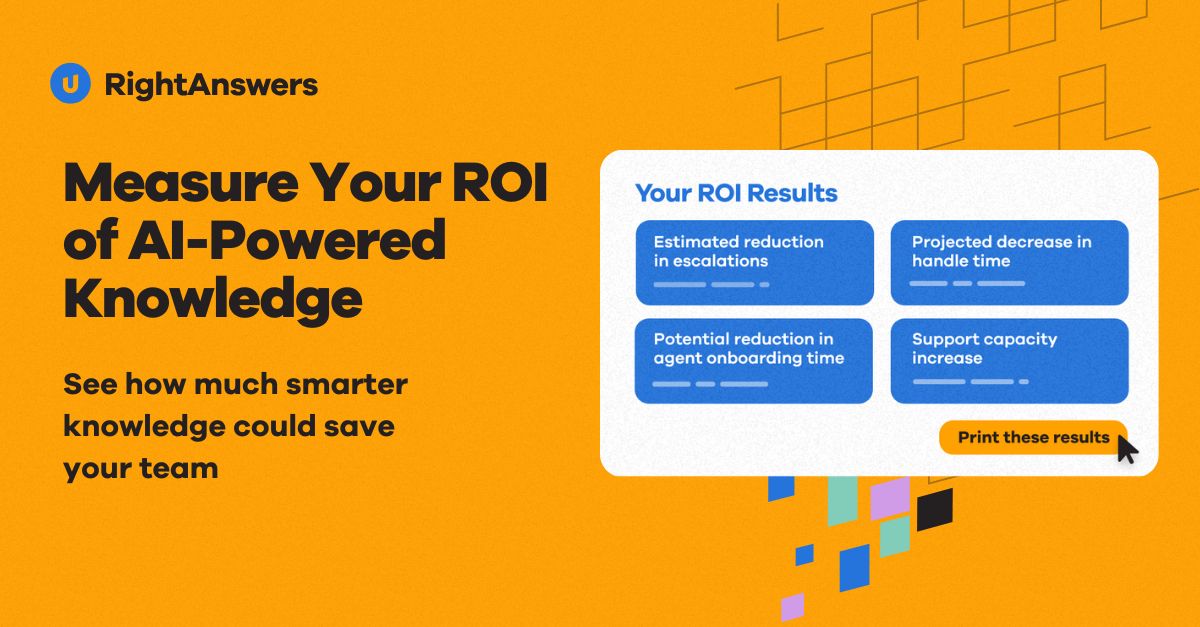
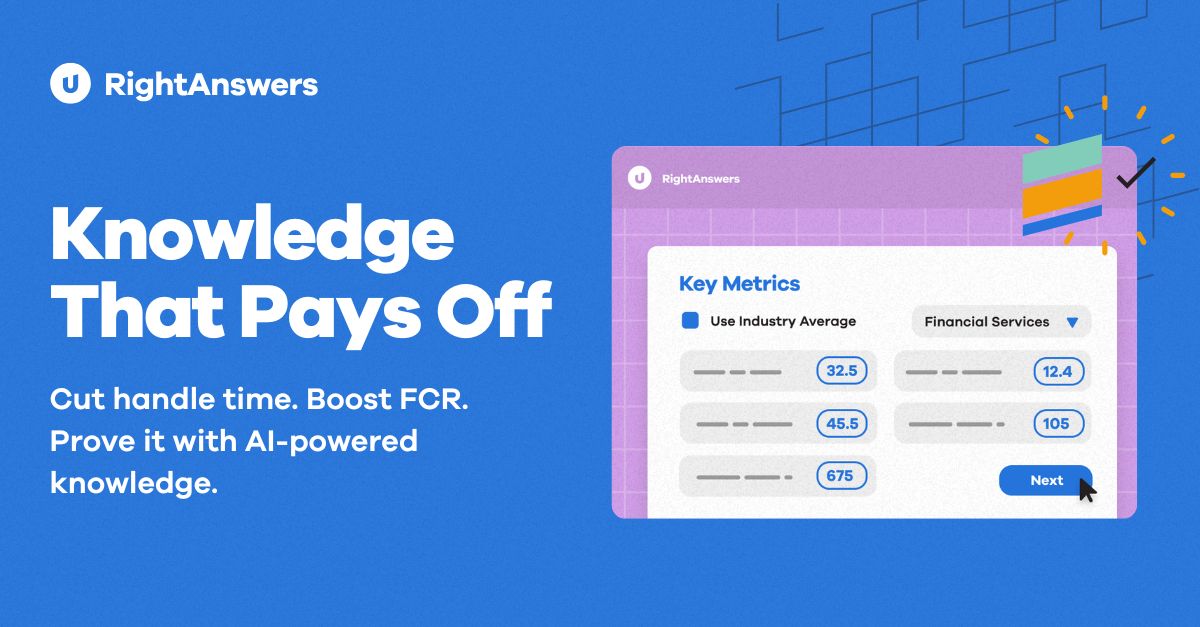
To help teams do just that, RightAnswers has created the ROI Calculator. It’s an interactive tool that estimates the business impact of AI-powered knowledge management across four main use cases. Use it to translate everyday support metrics into projected outcomes like time saved and potential cost reduction and get your ROI-focused ball rolling for 2026.
As you read, ask yourself: Which use case sounds most like my org right now?
Then you can run that scenario through the calculator using your own numbers.
Why Use Cases Make ROI Easier to Prove
The easiest way to show ROI is to connect KM to the work that’s most costly today, such as:
- Tickets that take too long to resolve
- Escalations that constantly pull in subject matter experts (SMEs)
- New hires who take weeks or months to onboard
- Customers who cannot find answers and end up contacting support anyway
- Teams wasting time searching for information or rewriting the same content
When you focus on a use case, you can line it up with the key performance indictaros (KPIs) that leadership already cares about, like average handle time (AHT), first contact resolution (FCR), escalations, and onboarding time.
That’s why we created the RightAnswers ROI Calculator. You pick the use case, we provide the results.
Calculate your ROI
Use Case #1: Internal Tech Support
Reduce escalations, speed up onboarding, and resolve tickets faster
Who this is for:
IT service desks, internal help desks, and IT operations teams supporting employees.
What usually happens today:
Knowledge lives in too many places; paper files, computer folders, SME brains. Front-line staff can’t find answers fast enough, so escalations rise.
Where ROI shows up:
- Fewer escalations to Tier 2 and Tier 3
- Faster time to resolve issues
- Faster onboarding and shorter time to become fully productive
- More consistent support across teams and locations
What improves with AI-powered knowledge:
Instead of digging through multiple systems or asking annoyed coworkers time and again, agents get faster access to trusted, approved knowledge. This means issues get solved the first time, letting specialists and SMEs get their own work done (for once!).
How to use the calculator for this case:
If you know (or can estimate) ticket volume, escalation rate, handle time, team size, and onboarding time, you can get a strong ROI estimate quickly.
Use Case 2: Customer Service
Improve FCR, reduce HT and scale without adding headcount
Who this is for:
Support leaders and CX teams working to improve performance while controlling costs.
What usually happens today:
Product complexity continuously grows. Customers expect answers faster and faster. Agents struggle with inconsistent information across channels.
What improves with AI-powered knowledge:
RightAnswers is built for large, complex enterprises and supports structured knowledge workflows and governance. This helps teams keep content accurate, consistent, and usable across channels and teams.
Enter your ticket volume
Use Case 3: Customer Self-Service
Increase ticket deflection and decrease support costs
Who this is for:
Online support and self-service leaders on a mission to reduce inbound volume.
What usually happens today:
Customers want to solve problems on their own, but they can’t find answers with outdated content. Customers give up and pass the baton to contact support, increasing volume and costs.
Where ROI shows up:
- More successful self-service and higher ticket deflection
- Lower cost per resolution
- Fewer repeat contacts
- A better customer experience because answers are easy to find
What improves with AI-powered knowledge:
Customers find answers faster and trust what they see because knowledge is easier to find, easier to keep current, and better organized.
Run your customer self-service scenario
Use Case 4: Enterprise Knowledge Strategy
Break down silos, reduce time wasted searching, and support AI readiness.
Who this is for:
Knowledge leaders, digital transformation teams, and cross-functional operations teams.
What usually happens today:
Knowledge is spread across departments and tools. People unknowingly redo work or rely on tribal knowledge. AI projects stall because content is messy, outdated, or hard to govern.
Where ROI shows up:
- Less time spent searching for the right info
- Faster knowledge creation, reviews and updates
- Less duplicated content
- A clearer and more measurable business case for AI initiatives
What improves with AI-powered knowledge:
When knowledge is easy to find and well-managed, teams move faster across the business, which can support larger goals like efficiency, compliance, and AI adoption.
Estimate your time savings and productivity
How to Map Your Use Case Using the RightAnswers ROI Calculator
We designed the calculator to be quick and practical:
- Choose your use case
- Answer a few questions about your current situation
- Enter metrics like ticket volume, handle times, and cost assumptions
- View your results and get a personalized summary sent to your email
Turning Your Use Case into a Business Case
Once you have your results, make them as easy as possible for leadership to act on:
- Start with the operational problem
- Show the projected improvement
- Connect it to a priority that leadership cares about, like cost control
- Use the results to start up a conversation about next steps
Wrap Up: Pick Your Use Case, Prove Your ROI
ROI becomes a lot easier to understand when it’s tied to the work your teams do every day. Whether you want to reduce IT escalations, improve support performance, scale self-service, or build an enterprise-wide knowledge strategy, the starting point is the same:
- Pick the use case
- Enter your metrics
- Use the results to guide your next step