Transitioning to an AI-Powered Enterprise Knowledge Management Ecosystem
Transitioning to an AI-Powered Enterprise Knowledge Management Ecosystem
8 minute read


Today’s enterprise support teams face rising ticket volumes, mounting complexity, and pressure for instant, accurate answers. Outdated knowledge systems slow agents down and strain customer trust. Transitioning to an AI-powered knowledge ecosystem streamlines operations, accelerates resolution, and empowers teams to deliver expert support at scale.
Here is a practical, step-by-step roadmap to help you transition from a siloed database to a proactive, AI-driven knowledge engine.
1. The Strategic Vision: Solving the Velocity Crisis
Enterprises are dealing with a speed problem. A “Velocity Crisis.” This is not merely a challenge of speed, but a fundamental shift in the Velocity of Change within the organization.
In the past, support teams relied on static Standard Operating Procedures (SOPs) and massive PDF manuals. Those manual methods slow your agents down during high-stakes moments.
To survive this shift, you must move institutional intelligence out of static silos and into a real-time stream. You must stop focusing on storing information and start focusing on delivering clear answers.
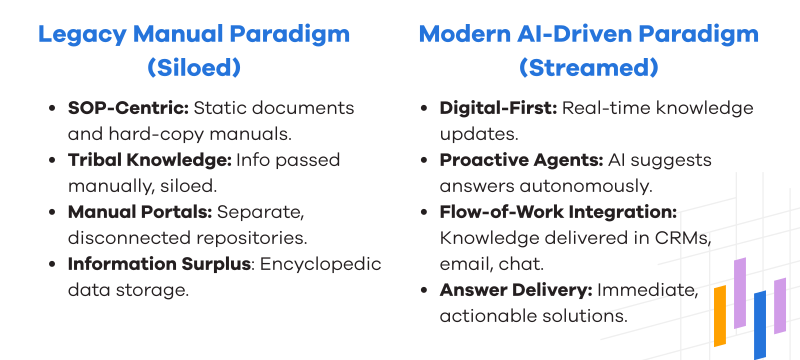
Here is how a modern AI-powered system compares to legacy methods:
Legacy Manual Paradigm (Siloed) |
Modern AI-Driven Paradigm (Streamed) |
SOP-Centric: Dependent on static, published documents and hard-copy manuals. |
Digital-First: Knowledge is captured and updated in real-time as a core part of the workflow. |
Tribal Knowledge: Information is siloed or passed manually “over the desk.” |
Proactive Agents: Specialized agents suggest answers and bridge knowledge gaps autonomously. |
Manual Portals: Users must exit their primary tasks to search separate, disconnected repositories. |
Flow-of-Work Integration: Knowledge is delivered directly within CRMs, email, and chat interfaces. |
Information Surplus: A focus on the “Encyclopaedia Britannica” model—storing volumes of data. |
Answer Delivery: A focus on noise reduction and providing immediate, actionable solutions. |
This evolution requires a pivot from “Information” to “Answers.”
Having vast amounts of information is no longer enough. If your agents have to read through a five-page document to find a single troubleshooting step, you lose valuable time. Modern systems prioritize immediate answer delivery.
2. Preparing the Foundation with Clean Fuel
AI is not a band-aid for disorganized documentation; it is a high-performance engine. This engine requires “Clean Fuel”—structured, high-quality data—to operate. If your foundational data is outdated, fragmented, or contradictory, AI will simply deliver the wrong answers faster.
To prevent “garbage in, garbage out” scenarios, knowledge must be architected with precision before deployment.
Clean Fuel Requirements:
- Single-Topic Focus (Chunking): Break your knowledge down into specific, single-topic articles. This practice, central to KCS v6 verified methodologies, allows AI models to parse and retrieve exactly what the agent needs without getting confused by unrelated data.
- Structured Metadata: Enterprise-wide tagging and taxonomy are essential. Proper tags allow the semantic search function to understand relationships between different concepts, making it easier for the AI to connect the dots.
- Strict Permissioning: The architecture must respect security boundaries, ensuring AI agents only pull from authorized “collections” or data segments.
The “Lipstick on a Pig” Risk
Deploying advanced Generative AI over poor-quality legacy repositories is a significant strategic risk—often described as “putting lipstick on a pig.” This approach does not fix underlying data failures; it merely masks them. Worse, it creates massive technical debt by rolling out uncontrolled AI solutions that provide incorrect or hallucinated answers. This leads to a trust gap among users; once the workforce loses confidence in the AI’s accuracy, the entire digital transformation effort will stall.
3. Governance and the ‘Human-at-the-Helm’
Because AI models can occasionally misinterpret data, you must shift your governance strategy from “human-in-the-loop” to “human-at-the-helm.” AI handles the heavy lifting of processing massive amounts of data, but a human expert must remain the ultimate authority on what is true and accurate for your business.
The modern knowledge manager’s role is evolving into a curator. Your responsibilities now focus on guiding the AI and ensuring it aligns with organizational reality.
- Validating AI-Generated Summaries: Ensures that automated outputs are consistent with strategic objectives and factually grounded.
- Autonomous Reconciliation: Use your AI to flag contradictory information or duplicate entries but require the human-at-the-helm to validate the final reconciliation to ensure it reflects current reality.
- Identifying White Space: Recognize knowledge gaps—the “what we don’t know”—that AI cannot perceive and requires human authoring to fill.
Governance of Guardrails
Knowledge Managers must collaborate with technical teams to set “Governance Guardrails.” This involves setting the parameters of how AI interprets data to prevent it from providing answers that deviate from current messaging or legal standards. Without these guardrails, users may inadvertently accept a plausible-sounding AI hallucination as a verified fact.
4. Moving from Simple Search to Smart Reasoning
The technical side of knowledge management (KM) is moving away from basic keyword searches. Traditional search is reactive; if an agent types the wrong keyword, they get no results. Modern AI architecture focuses on reasoning. It synthesizes past experiences, current data, and established methodologies to provide a complete solution.
Think of an advanced enterprise system as an “Agent of Agents.” In this setup, a main intelligent router acts like a traffic cop. When an agent asks a complex question, the main router delegates the task to specialized AI agents in different departments, like billing, tech support, or legal. These agents work together instantly to build a comprehensive answer.
Here are the core technical concepts behind this shift:
- Semantic Context: The system understands that words mean different things in different departments. A “ticket” in customer service is very different from a “ticket” in a transportation context.
- Vector Databases: Instead of matching exact keywords, AI uses vector databases to understand the intent behind a search. It summarizes the problem and the solution instead of just handing the agent a list of stale blue links.
- Flow of Work Delivery: The goal is to eliminate context switching. By bringing AI-powered knowledge directly into your existing CRM, agents stay in their productive flow.
The most elegant architecture will collapse under the weight of a resistant culture; therefore, implementation must be phased, deliberate, and supported by a robust cultural strategy.
5. Implementation Strategy: Phased Execution
Strategic leaders must adopt a “Don’t Boil the Ocean” philosophy. Success is found in manageable, iterative wins that build momentum and demonstrate value without exhausting organizational resources.
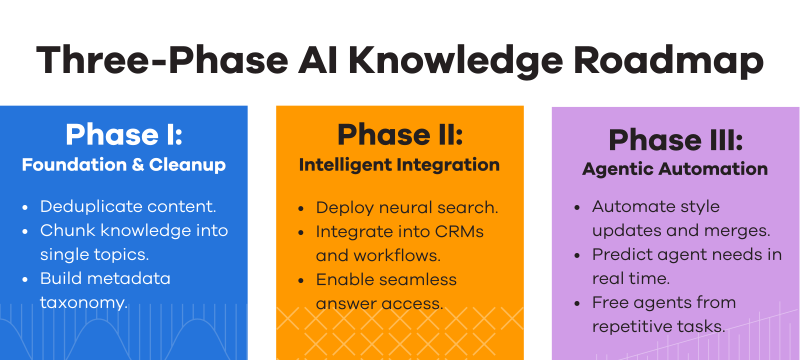
Three-Phase Implementation Roadmap:
- Phase I: Foundation & Cleanup: Prioritize fuel cleaning. Focus on deduplication, chunking knowledge into single-topic focuses, and establishing a robust metadata taxonomy. In other words, get your database KCS-ready.
- Phase II: Intelligent Integration: Implement neural search and meet employees where they are. This includes deploying tools for meeting summarization and integrating KM into existing daily workflows (e.g., Teams, CRM).
- Phase III: Agentic Automation: Once the foundation is solid and trust is established, deploy proactive AI features. Let the AI handle automated style updates, suggest content merges, and predict what answers an agent might need based on the customer’s live chat context.
The Socialization of AI
The greatest barrier to adoption is cultural resistance. Successful execution requires the Socialization of AI—shifting the workforce mindset from “AI does the thinking for me” to “AI removes the busy work so I can be more effective.” Change management must focus on ensuring employees believe they can succeed with these tools and understand that they remain at the helm.
6. Measuring Impact: Defining Success and ROI
To keep your executive team on board, you need to prove that your AI-powered knowledge platform is a smart investment. You must measure the impact precisely and distinguish between different types of wins.
Quantitative Metrics (Time Capsule Tasks) |
Qualitative Metrics (Professional Services) |
Transaction Speed: Seconds saved on routine tasks like password resets. |
Ease of Discovery: Survey-based data on how much easier it is for staff to find complex info. |
Usage Volume: The number of successful AI-assisted interactions/queries. |
Self-Reporting Data: Personal estimations of time saved by professional services staff. |
Accuracy/Resolution: Reduction in “trust gap” incidents and escalations. |
Cultural Sentiment: Measuring user adoption and “buy-in” across departments. |
The Ripple Effect of Micro-Savings
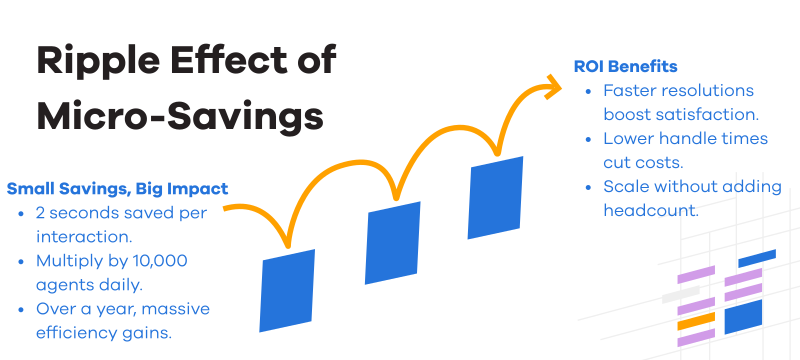
The ROI of an AI-powered ecosystem is often found in the “Ripple Effect.” While saving two seconds on a single interaction may not seem like much, multiplying those two seconds across 10,000 agents over 365 days results in massive, aggregated organizational gains.
A successful transition to an AI-powered KM ecosystem is not a one-time project, but a journey of agility, deliberate data quality, and unwavering human leadership. By focusing on “clean fuel” and keeping a human “at the helm,” the enterprise can solve the velocity crisis and turn collective knowledge into a proactive engine for growth.
Ready to see how RightAnswers can help you accelerate this transformation?
Watch the webinar on demand, request a personalized demo, or contact our team to discuss your unique knowledge management goals. Empower your enterprise—start your AI-powered journey with RightAnswers today.