Closing Compliance Gaps in National Banks
Closing Compliance Gaps in National Banks


Picture this: a large national bank has just expanded its contact center from two regional hubs to five, onboarding 800 agents over 18 months to support a new retail banking product line. Leadership celebrates this as a growth milestone. But on the ground, operational risk is brewing.
Those new agents were handed a knowledge base never intended for finance at this scale. Articles created for one business unit are misapplied to others. Knowledge searches produce ten near-duplicates of the same compliance policy from different teams. Senior agents spend valuable time coaching new hires mid-call because the current financial services knowledge management approach leaves too much room for uncertainty.
It’s a scenario familiar across the finance sector. Banks and large financial institutions that scale headcount and service channels without modernizing knowledge management in finance build compounding risks—operational shortfalls now, regulatory exposure tomorrow. The larger the institution, the sharper this risk becomes: more agents and product lines, more regulations to track, and more customer touchpoints where a single inconsistent answer could do real harm.
Effective knowledge management for banks is not a support side project. It’s an operational and compliance discipline essential to every national bank.
Why Knowledge Management Breaks Down in Finance at Scale
Failure to invest in robust financial services knowledge management introduces vulnerabilities that multiply with each new agent, product, and channel. Let’s break down what goes wrong:
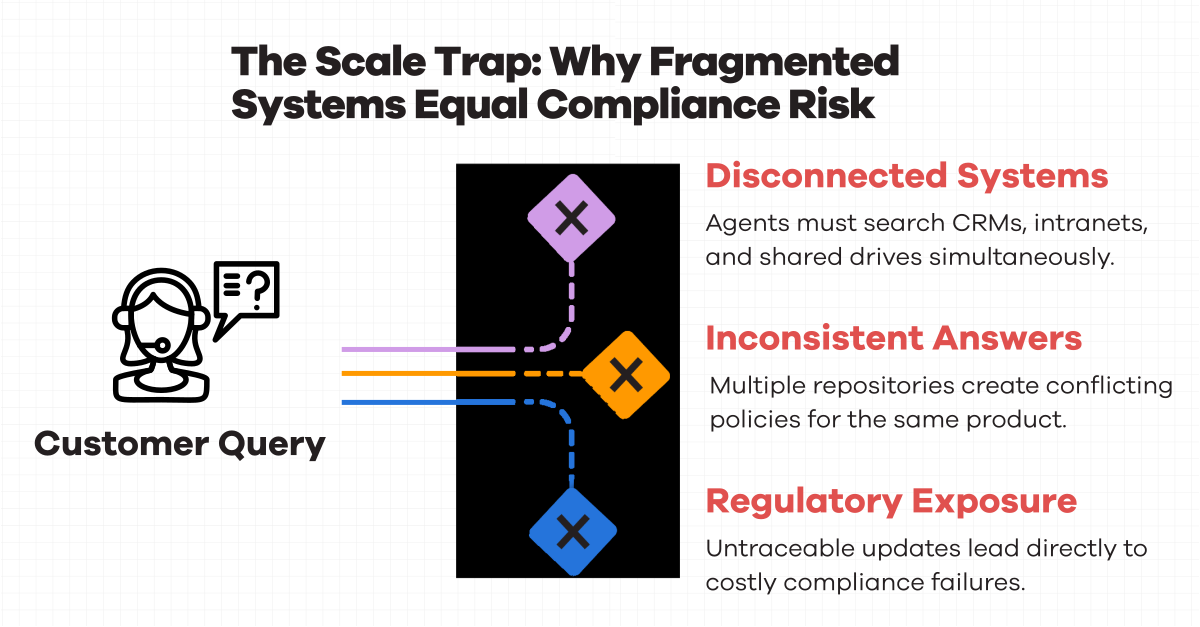
The multi-system maze in financial services
Think of an agent working a mortgage inquiry. They’re toggling between the CRM, a product intranet, and a regulatory drive, all to answer a basic escrow question after a compliance update. They still aren’t sure which policy version is current.
Financial services knowledge is typically fragmented across CRM databases, SharePoint intranets, internal drives, and specialized business repositories. Each was designed for a specific need, but none deliver unified, up-to-date answers for agents in real time. For a smaller team, supervisors and informal peer networks might mask the breakdown. At a national bank? Fragmented knowledge becomes a systemic governance failure, with agents forced to guess or escalate.
Product and compliance complexity
A national bank agent may field questions spanning retail deposits, consumer lending, mortgage servicing, and small business solutions in a single afternoon. Every line of business maintains its own knowledge hub, each with distinct fee structures, disclosures, and evolving regulatory rules.
This complexity is only manageable if knowledge management systems are unified across products and teams. Too often, financial services knowledge management does not span product lines, leaving agents and customers at risk when information crosses boundaries.
Regulatory change and the burden of proof
Policy terms, Reg E timeframes, Truth in Lending disclosures—these all shift constantly as regulations evolve. Updates must reach every agent, through every channel, without delay. In smaller environments, compliance teams can push updates manually and confirm adoption. In a national bank, that manual process breaks down entirely. Outdated and current guidance co-exist, and agents have no way to know which to trust.
Mergers compound the knowledge problem
When banks merge, so do their knowledge environments, often with little forethought. Separate knowledge architectures, naming conventions, and approvals end up clashing. Merging knowledge as part of post-merger integration is frequently neglected, even though this is precisely when knowledge management in finance is most essential to regulatory compliance and customer trust.
Compliance and Operational Impact: The Consequences of Poor Knowledge Management in Banks
When agents sift through multiple systems to find answers, the downstream effects are deeply measurable and costly.
Average handle time spikes as knowledge gaps hide in plain sight
Search time in fragmented systems is absorbed into Average Handle Time (AHT), often attributed to case complexity instead of the real culprit: subpar financial services knowledge management. For a national bank handling say, 40,000 daily calls, a 20-second search delay translates into thousands of hours a month lost to navigation, and not customer resolution.
First contact resolution drops, escalations rise
Agents lacking confidence in the knowledge base either escalate to supervisors or try out educated guesses. In both cases, costs and risks climb. Poor financial services knowledge management means customers get conflicting answers or wait for supervisor input. Both of which erode trust and regulatory standing.
Ramp time grows, agent confidence slows
With every product and regulation to master, agents in finance face long learning curves. Unreliable knowledge increases ramp-to-competency times. Industry benchmarks for new agents in regulated finance environments already average 8–12 weeks; fragmented knowledge management in banks stretches that further, driving up onboarding costs and extending exposure.
Examiners focus in on knowledge management in finance
Regulatory bodies now expect banks to prove they can deliver accurate, current information in every answer, every time. Findings under UDAAP (Unfair, Deceptive, or Abusive Acts or Practices) frequently hinge on whether knowledge management practices can demonstrate who knew what, and when.
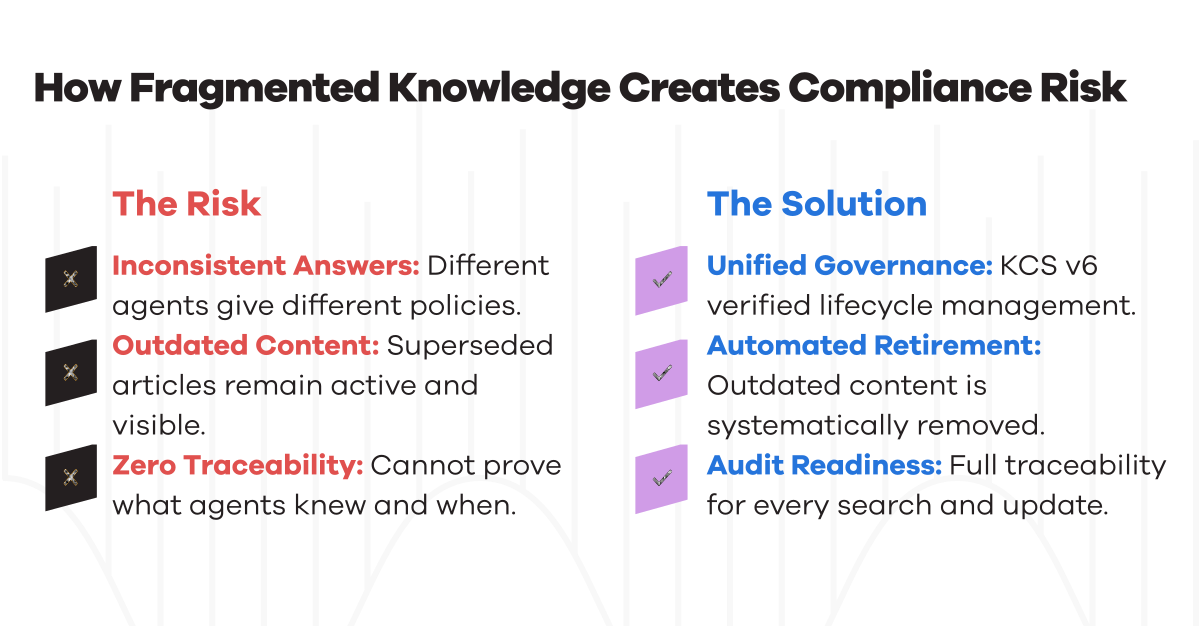
The cost of a single compliance penalty often dwarfs the investment required for strong financial services knowledge management. Proactive governance is no longer optional, but essential for risk mitigation and operational integrity.
More Training Isn’t the Answer: Addressing Root Causes in Financial Knowledge Management
When performance metrics slip, more agent training is typically the first response rather than the solution.
Training addresses symptoms, not systemic issues: You can train agents to use knowledge, but if the knowledge management system in finance is fragmented or out of date, well-trained agents are still left navigating unclear or conflicting resources. The training budget is spent, but the structural knowledge risk persists.
Supervision can’t scale knowledge management for banks: Supervisors and senior agents may catch knowledge gaps for small teams, but at enterprise scale, that safety net cannot handle the load. True knowledge management in finance must be embedded, automated, governed, and auditable.
What Effective Financial Services Knowledge Management Really Looks Like
World-class knowledge management for banks is not about collecting more files or building bigger repositories. SharePoint, Confluence, and similar platforms are content management tools, not strategic knowledge management solutions for finance.
Governed knowledge lifecycle for national banks
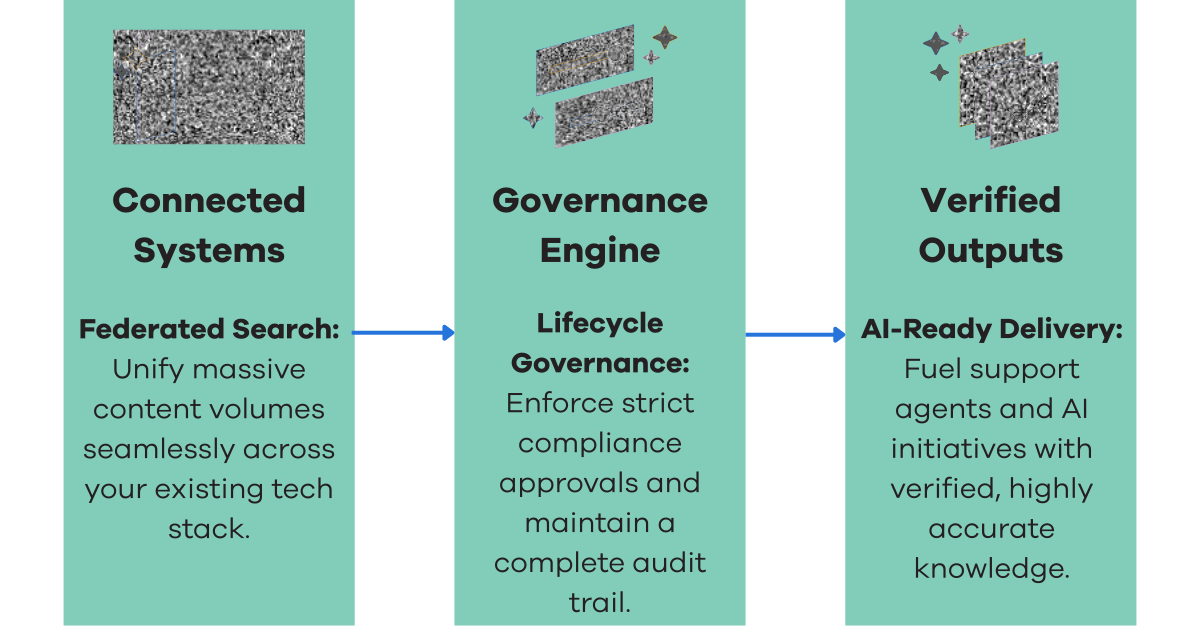
Here’s what robust knowledge management in finance should look like:
- Creation: New content is reviewed against current financial regulations before being published. RightAnswers shortens this cycle with AI-assisted creation and duplicate detection, reducing time by up to 85%.
- Approval: Regulated product details require expert or compliance team sign-off. Governed, systematized review and approval processes eliminate inconsistencies.
- Delivery: Knowledge is surfaced to agents in real time, within core banking applications via federated search, removing the need to hunt for reliable answers.
- Retirement: Superseded documents are automatically flagged and removed, so only current guidance is accessible.
- Audit Trail: Every edit, review, and usage event is logged for clear regulatory traceability, making every answer defensible.
Laying the foundation for compliance-ready AI in finance
As banks accelerate investment in AI (think: chatbot advisors, generative answers, predictive search), the effectiveness of these tools depends entirely on the foundation of financial services knowledge management beneath them. AI deployed atop a fragmented or ungoverned base multiplies errors and inconsistencies; it can only deliver reliable results if the knowledge it draws from is current, unified, and verified.
RightAnswers empowers banks with BYOAI (Bring Your Own AI) flexibility, federated search, generative answers, and a KCS v6-verified knowledge governance framework. This enables true knowledge management for finance—scalable, compliant, and fit for the demands of modern banking.
Unifying Knowledge Management in Finance: The Measurable Impact
Let’s focus on what measurable, enterprise-scale knowledge management in finance can achieve:
- 4× faster issue resolution by unifying knowledge across systems and teams
- 49% faster search speed with federated, full-cycle knowledge access
- 80%+ accuracy for AI-generated answers thanks to trusted, governed information
- No headcount increase. Knowledge scales with the business, not labor costs
With RightAnswers, agents stop wasting time searching and deliver expert answers at the moment of need. The result is lower operational costs, higher customer satisfaction, immediate audit readiness, and a robust infrastructure for future AI deployments in finance.
Conclusion: Strategic Knowledge Management for Finance Drives Compliance and Performance
Financial institutions face mounting compliance demands, complex product portfolios, and high customer expectations. Fragmented information is an unacceptable risk. Knowledge management in finance is now a strategic discipline, not an IT side project.
By investing in centralized, full-lifecycle knowledge management for banks, you reduce the operational cost of compliance, deliver greater consistency to customers, and create a strong foundation for trustworthy AI.
Are you ready to transform your financial services knowledge management and protect your institution from the risks of scale? Request a demo of RightAnswers today and learn how to drive compliance, efficiency, and trusted outcomes. Every answer, every time.