AI Knowledge Readiness: The Missing Layer for AI
AI Knowledge Readiness: The Missing Layer for AI

Your Data Is Ready for AI. Your Knowledge Probably Isn’t.
Most enterprises have spent years and serious budget getting their data house in order. Structured records, clean pipelines, governed datasets. Then they point AI at all that hard work and get answers that feel confident and turn out wrong.
Sound familiar?
In a recent Forbes Technology Council article, Sean Nathaniel, CEO of Upland, names the problem directly: data readiness is not the same as knowledge readiness. And when you treat them as if they are, your AI can access the records but not the judgment behind them.
It’s worth unpacking why, because the symptoms show up everywhere, especially in IT support and service operations.
The same problem, seen from different seats
Nathaniel points out that this gap looks different depending on where you sit:
- Data and technology leaders approved AI investments assuming their data foundation was enough.
- Contact center and IT support leaders watch it play out in real time. Agents get AI-assisted answers that cite outdated policies. Self-service tools contradict themselves. Customers escalate because the bot couldn’t connect the dots across related issues.
Same root cause, different view. The AI isn’t broken. The knowledge foundation beneath it isn’t ready.
Why data alone can’t carry AI
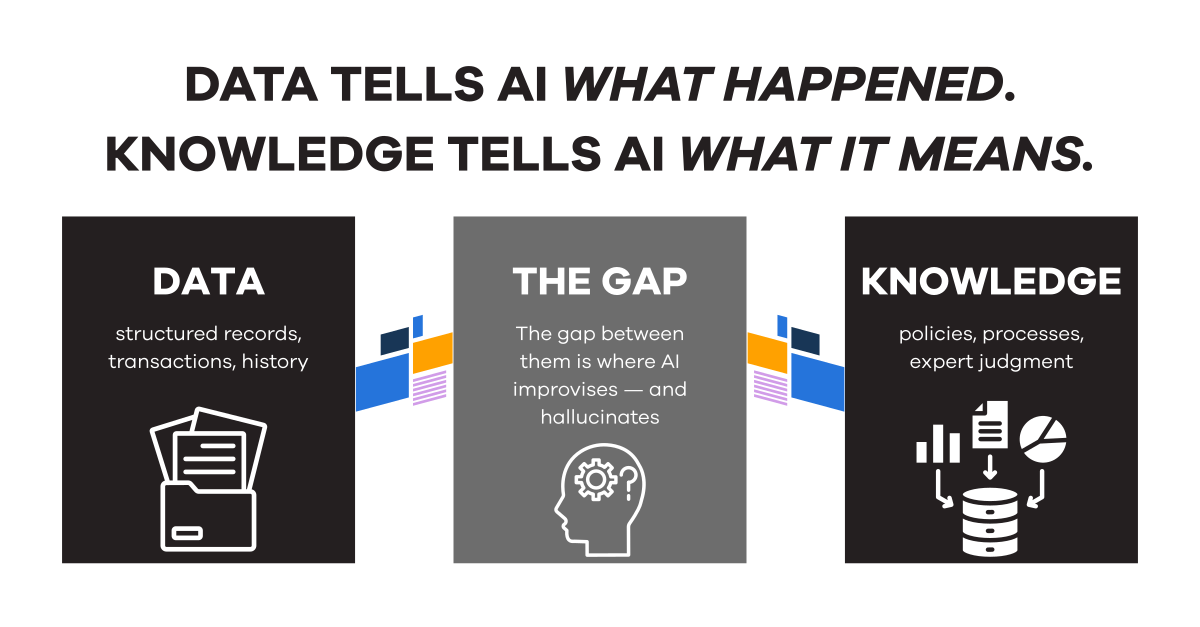
Structured data is the layer most organizations already know how to govern. It tells AI what happened. A customer record shows the transaction, the account, the history.
What it can’t tell AI is what any of that means.
How was this relationship actually built? Which business rules govern this account? What institutional judgment shaped the last major decision here?
That context doesn’t live in your data warehouse. It lives in your knowledge: the policies that govern how work gets done, the processes that encode years of institutional learning, the taxonomies that define how your organization thinks about its own domains, and the expert directories that map who knows what.
As Nathaniel puts it, these assets are your organization’s understanding of itself, made explicit. They give AI the context to interpret information, not just retrieve it.
When you skip that layer, AI improvises. And confident-sounding improvisation at AI speed and scale is exactly where hallucinations come from.
The knowledge readiness gap
Here’s the part support and KM leaders feel most acutely: most knowledge bases were built for humans, not AI.
A person types a query, scans the results, reads an article, and applies judgment about which answer fits. AI can’t do that on its own. It needs the semantic layer that human readers supply instinctively:
- Which policy supersedes which
- Which expert’s guidance applies in which situation
- How one knowledge asset relates to another
Without that layer, AI sees an unstructured pile of text instead of a coherent map of how your organization thinks.
Nathaniel shares a scenario that will feel painfully familiar to anyone running a contact center. An organization deploys agent-assist AI on top of a well-maintained knowledge base. Agents trust it for simple questions. But when a case requires applying a recently updated procedure, or synthesizing two related policies, the AI blends old and new guidance into something neither version ever actually said. The knowledge was there. What was missing was the semantic layer telling AI which article applied, when, and which version was current.
The agent gets a confident, wrong answer. The customer pays for it.
The same dynamic plays out whether your team is handling customer service interactions, running an IT help desk, or supporting customer self-service. AI will only perform as well as the knowledge you’ve given it to work with.
And knowledge bases rot. Policies get updated but old versions linger. Expert directories go stale. Without governance built with AI in mind, even a strong knowledge system becomes a liability.
Four steps to make your knowledge AI-ready
The good news from Nathaniel’s article: you don’t need to rebuild your knowledge assets. You need to enrich, connect, and govern them with AI consumption in mind. This is exactly the practice that AI knowledge management is built around.
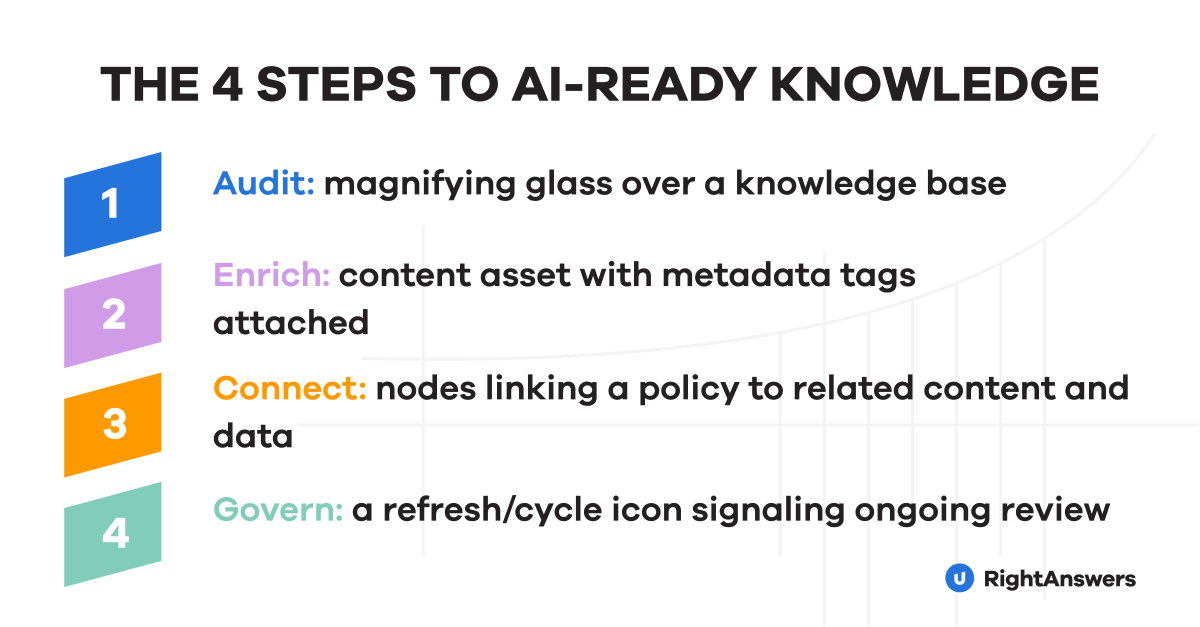
- Audit what you have before assumingit’sready.
Most organizations overestimate how AI-ready their knowledge really is. Assess the current state honestly. How current is the content? Is metadata applied consistently? Are the relationships between assets explicitly mapped, or invisible to a machine? Nathaniel notes that the audit almost always reveals a knowledge base more valuable than anyone realized, and less ready than anyone assumed. - Enrich withthe semantic layer AI needs.
The highest-impact move is metadata enrichment: adding structured context that tells AI how to interpret and relate your knowledge. Tag content with roles, domains, relationships, and hierarchy. Map which policy governs which process, and which expert owns which domain. As Nathaniel notes, this is a discipline problem, not a technology problem. The tools exist. The organizational commitment usually doesn’t. - Connect knowledge to the content and data around it.
A policy connects to the contracts it governs. An expert directory connects to the projects thatperson worked on. A process document connects to the operational data that measures whether it’s working. Make those links explicit, and your knowledge base stops being a reference library AI retrieves from and becomes something AI can actually reason across. - Govern for AI, not just for humans.
AIdoesn’t browse. It ingests. Stale content a human would instantly recognize as outdated gets treated as current. Conflicting entries a human would resolve through judgment will confuse a machine trying to synthesize. That means regular review cycles, explicit retirement of superseded content, and ongoing validation of the semantic layer.
This last point is where the Knowledge-Centered Success (KCS) methodology earns its keep. KCS provides the workflow and accountability structure that keeps knowledge current at scale. As Nathaniel observes, organizations that have adopted KCS are simply better positioned for AI readiness than those governing knowledge informally.
The half of the job most teams skipped
Your data readiness work wasn’t wasted. But as Nathaniel argues, it was incomplete.
Data can be reacquired. The accumulated expertise of your organization, the hard-won understanding of how the work gets done, what the rules are, and what the exceptions mean, took years to build and can’t be quickly reconstructed if it’s left inaccessible to the systems you’re now relying on.
When that knowledge is structured with context, connected to the data around it, and governed to stay current, AI stops reflecting what it can infer and starts reflecting what your organization actually knows. That’s the difference between AI your teams trust and AI they quietly ignore.
Where RightAnswers comes in
RightAnswers was built for this challenge. As a KCS v6 verified Enterprise Knowledge Management Platform, RightAnswers helps large tech, finance, and telecom teams turn a scattered, human-first knowledge base into a governed, connected, semantically rich foundation that AI can actually trust and act on. For a deeper look at how AI and knowledge management work together, explore our AI knowledge management overview.
Take the AI Readiness Assessment to benchmark where your knowledge stands today across structure, governance, and discoverability and get clear next steps on closing the gaps before they limit your AI outcomes.
Or, request a demo to see how RightAnswers keeps governance built into the workflow, so knowledge stays accurate, current, and ready for whatever AI you’re running on top of it.