Moving to a Modern Knowledge Portal
Moving to a Modern Knowledge Portal
6 minute read


Support and knowledge management leaders face a critical turning point. Legacy knowledge bases no longer deliver the speed, accuracy, or efficiency enterprise teams need. In a recent KMWorld webinar, “Moving to a Modern Knowledge Portal,” RightAnswers experts Alex Baker and Rosemary Kirk joined Marydee Ojala to explore the evolution of knowledge management. They unpacked how organizations can transform static, frustrating repositories into highly scalable, AI-powered platforms that empower agents and drive measurable results.
If your team struggles with slow onboarding, high ticket volumes, and knowledge silos, modernizing your portal is the most effective path forward. Here we’ll summarize the crucial insights and actionable takeaways from the expert session, highlighting exactly what it takes to build a trusted, seamlessly integrated knowledge ecosystem.
The Shift from Search to Answers
The biggest evolution in enterprise knowledge management is the fundamental shift from finding information to delivering instant, accurate answers. Users no longer want to dig through pages of keyword-matched documents. They expect the exact answer they need, right at the top of their search results.
A modern knowledge portal relies on AI-powered, intent-based search to understand the context behind a query. If an agent types a customer’s specific, conversational problem into the search bar, the system must comprehend the intent rather than forcing the agent to translate the issue into rigid corporate terminology. This capability drastically reduces time-to-resolution and eliminates the friction that causes frontline agents to abandon the knowledge base.
Organizations must prioritize answer delivery and generative AI capabilities to keep up with user expectations. Seamless integration into existing workflows, such as your CRM or ITSM, ensures that AI-powered knowledge surfaces exactly where agents already work, completely avoiding the context-switching that drains productivity.
Curation Beats Accumulation
A massive misconception holding enterprises back is the idea that more content equals better knowledge. Over the years, organizations hoard thousands of outdated documents, creating a chaotic environment where finding the right answer becomes impossible.
During the session, the speakers emphasized a simple but powerful rule: “When in doubt, throw it out.” Outdated content pollutes search results and destroys agent trust. A modern platform must feature robust governance and lifecycle management to ensure accuracy. Quality always outweighs volume. By curating your content and maintaining strict quality standards, you build a verified foundation that allows AI tools to function correctly. Without trusted knowledge, AI-powered search simply scales bad information.
AI as an Augmentation Tool, not a Replacement
Many organizations approach artificial intelligence with hesitation, fearing it will replace human expertise or operate without guardrails. However, the strongest and most successful enterprise use cases position AI strictly as an augmentation tool designed to empower your teams.
AI functions best when it amplifies productivity for both agents and content authors. High-value applications discussed in the webinar include:
- Generating structured knowledge articles directly from raw case notes.
- Detecting duplicate content automatically to keep the portal clean.
- Providing generative answers based exclusively on curated, approved company knowledge.
- Delivering actionable reporting insights to identify knowledge gaps.
By leveraging AI to handle tedious formatting and initial drafting, subject matter experts and KCS coaches can focus their energy on refining content and improving the overall customer experience.
Practical Benefits of Modernization
Transitioning to a modern knowledge portal unlocks immediate, measurable ROI for the entire organization. When agents have instant access to accurate answers within their workflow, the business experiences transformative results.
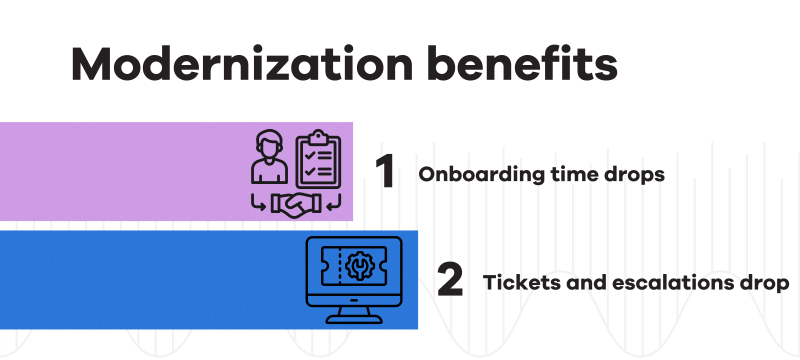
First, onboarding time drops significantly. New hires no longer need to memorize complex product catalogues or navigate confusing folder structures. They can rely on the portal to guide them through customer interactions, reducing their ramp-up time from months to weeks.
Second, support ticket volumes and escalations decrease. When frontline agents can confidently resolve complex issues on the first touch, fewer cases require escalation to tier-two support. Furthermore, exposing this same high-quality, AI-powered search to customer-facing self-service portals empowers users to solve their own problems, deflecting tickets before they ever reach your service desk.
Signals You Are Ready for Change
Organizations typically realize they need a new approach when the pain of their current system becomes quantifiable. If you are evaluating your tech stack this year, look for these clear signals that indicate it is time to modernize:
- Agents spend excessive time searching for answers across multiple, disconnected systems.
- New hire ramp time is dragging down operational efficiency.
- Knowledge remains siloed across different departments, preventing cross-functional collaboration.
- Agents express visible frustration with outdated search capabilities.
- Support costs and escalation rates continue to rise despite previous interventions.
These triggers highlight a fundamental breakdown in knowledge delivery. Acknowledging these pain points is the first step toward building a business case for a scalable, enterprise-grade solution.
Adoption is the Real Failure Point
Technology rarely causes a knowledge management initiative to fail. The true failure point is always user adoption. Companies frequently invest heavily in sophisticated platforms but treat change management as an afterthought, resulting in beautifully designed portals that quickly become empty “ghost towns.”
Successful modernization requires a strategic focus on cultural change. Organizations need internal champions, proper incentives, and sustained enablement to shift user behavior. You must answer the fundamental question for every user: “What is in this for me?” By embedding the knowledge portal directly into their daily workflow and making it incredibly easy to contribute, you empower agents to take ownership of the knowledge base.
Take the Next Step in Your KM Journey
Modernizing your knowledge portal is not just about updating software; it is about transforming how your entire enterprise captures, shares, and utilizes information. By prioritizing AI-powered search, stringent curation, and seamless workflow integration, you can scale your support operations without needing to increase headcount.

Take the insights from this session and apply them to your own environment. Watch the full on-demand recording of the KMWorld and RightAnswers webinar, Moving to a Modern Knowledge Portal, to dive deeper into these strategies.
If you want to map out exactly what this transition looks like for your specific tech stack, reach out to our team to book a 15-minute portal modernization assessment with RightAnswers. We will help you identify your biggest opportunities for AI-powered efficiency and build a roadmap toward a trusted, scalable knowledge ecosystem.