AI Knowledge Management: Reducing Hallucination Risk Across Multiple Systems
AI Knowledge Management: Reducing Hallucination Risk Across Multiple Systems


Many organizations believe connecting multiple AI knowledge management bases automatically improves AI accuracy, but if this connection isn’t done correctly, it often gets worse.
You invest in the latest generative AI tools, expecting them to instantly synthesize your massive library of data. You point the AI at your various repositories like support wikis, IT service portals, and legacy document drives. Suddenly, your support agents start receiving contradictory answers, and you notice customer satisfaction scores begin to drop and AI trust really takes a nosedive.
The explosion of knowledge silos across enterprise environments has created a huge challenge. Content becomes outdated quickly. Different departments maintain conflicting versions of the same standard operating procedure. While these issues have existed for years, implementing AI may seem like a quick fix but what it does instead is expose typically ignored governance gaps almost immediately.
AI does not hallucinate randomly; it just reflects the inconsistencies within the knowledge itself. This is why having a strong knowledge management strategy driven by proven methodologies like KCS (Knowledge-Centered Service), forms the solid foundation of successful AI knowledge management implementation.
The AI problem you didn’t know you had
Enterprise organizations often manage complex operations with 10,000 or more articles spread across dozens of systems. When you adopt an AI knowledge platform, the natural instinct is to feed it anything and everything. More data means better answers, right?
Not so fast. This approach ignores the reality of how enterprise information inevitably goes downhill over time. When an AI model ingests unverified, duplicated, or outdated content, it cannot easily determine which version represents the current truth. The real truth. It attempts to merge conflicting answers, leading to inaccurate outputs that your agents cannot trust, or even worse, trust blindly because AI is supposed to know everything.
The most effective way to reduce AI hallucination risk is not building better AI. It is building better knowledge.
High-quality knowledge is validated, continuously improved, owned by subject matter experts (SMEs), and designed for reuse. Without these elements, unleashing your AI only scales your existing dysfunction.
Why searching across multiple knowledge bases amplifies risk
Searching across multiple knowledge bases becomes risky when your information lacks strict governance. If ownership remains unclear and validation is not consistent, your AI tool quickly becomes a liability rather than an asset.
Consider this: an escalations agent needs to resolve a critical software issue. The AI searches the entire tech stack and pulls up three different articles. One contains outdated troubleshooting steps from two years ago. Another is a duplicated article with slight modifications made by a well-meaning but misinformed junior agent. The third is an unverified document from a team that no longer exists.
The AI might blend all three articles into a single, nonsensical set of instructions. When agents follow these flawed steps, resolution times spike, and escalations to senior engineers increase.
Having the full picture of your current landscape helps you set up your knowledge management software in a way that ensures only the right information you want feeds your AI functions. You must control the inputs to trust the outputs.
How to strengthen knowledge before expanding AI
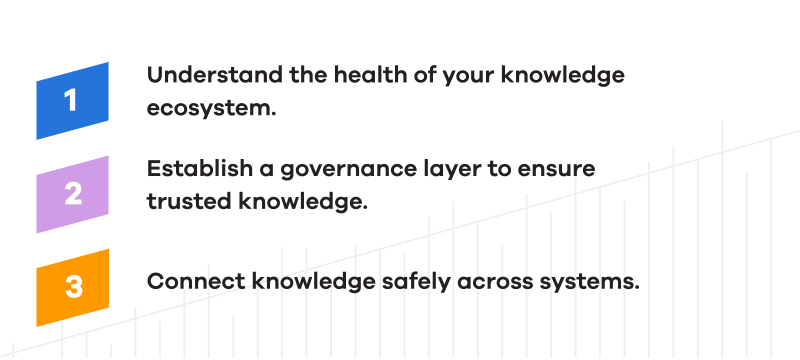
Before you attempt to scale your AI initiatives, you need to fix the data it relies on. Here is how enterprise organizations can strengthen their knowledge foundations to ensure accurate, AI-powered efficiency.
Action 1: Understand the health of your knowledge ecosystem.
You cannot fix what you don’t understand. Organizations unsure of their risk exposure need a clear diagnosis before moving forward. This is where KCS Professional Services serve as an ideal starting point.
Expert consultants help you identify critical knowledge gaps across your organization. They surface conflicting information hidden deep within your old, cobweb-ridden systems. By evaluating your AI readiness, they help you to close any knowledge gaps you have and ensure you do not deploy an AI knowledge management tool on top of a broken foundation.
See how RightAnswers professional services helped Protective Life scale its modern knowledge ecosystem by highlighting which repositories contain trustworthy data and which ones required immediate revision.
Action 2: Establish a governance layer to ensure trusted knowledge.
Once you understand your knowledge ecosystem, you need to establish strict governance. Organizations need a systematic way to ensure only validated knowledge surfaces in search results. You must resolve conflicting information proactively and guarantee that knowledge remains accurate over time.
A comprehensive knowledge management tool like RightAnswers, managed by a dedicated team focused on maintaining high knowledge standards, serves as the critical governance layer your organization needs. By leveraging KCS v6 verified workflows, you can systematically transform fragmented, siloed content into unified, enterprise-wide knowledge that delivers reliable and consistent answers.
When an agent searches for an answer, the platform ensures that AI only pulls from certified, up-to-date articles. If an agent identifies a gap, the KCS methodology empowers them to flag or create content, which then passes through a structured validation process before feeding back into the AI model.
Action 3: Connect knowledge safely across systems.
For organizations with diverse tech stacks, consolidating everything into a single repository is rarely feasible. You cannot just simply eliminate existing systems. Therefore, connecting knowledge safely across these platforms without causing operational disruptions becomes critical.
Modern architectures offer flexible solutions, such as a headless option, allowing you to decouple the front-end experience from the back-end repository. This seamless integration enables your AI to access governed data across various systems while maintaining strict quality control. You deliver scalable, accurate information directly into the flow of work, right when your agents need it.
Ready to chat about RightAnswers API or discover your integration needs?
Better knowledge. Better AI.
Organizations focused exclusively on tweaking their AI algorithms will continue to struggle with hallucination risks. The root cause of the problem lies in the data, not the technology.
Those who invest in strengthening their knowledge foundations will achieve more reliable, scalable AI outcomes. By leveraging KCS methodologies, establishing a robust governance layer, and safely connecting your systems, you empower your support teams to resolve issues faster and with complete confidence.
Transform your support operations by taking control of your content today. When you build a resilient ecosystem, AI becomes the powerful accelerator it was always meant to be.
Curious how your organization stacks up for AI-powered success? Find out with our AI readiness assessment.