From Service to Success: Why KCS Just Raised the Bar
From Service to Success: Why KCS Just Raised the Bar


KCS recently updated what it stands for. Knowledge Centered Service is now Knowledge Centered Success.
At first glance, it might seem like just another small terminology update. But it actually exposes a hard truth about how we run support operations. This word change signals a fundamental shift in how support teams must operate to survive.
What Changed
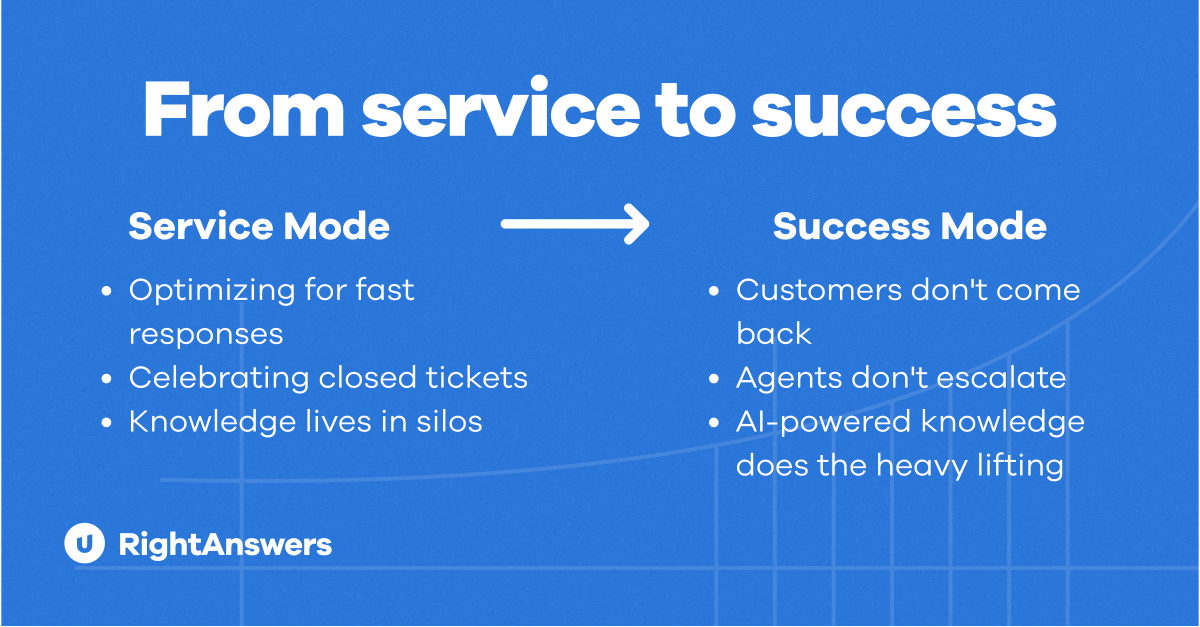
For decades, we have optimized for service. We measure handle times. We track how fast agents respond. We celebrate closed tickets.
The new KCS definition shifts the focus entirely from outputs to outcomes. A closed ticket is an output. A resolved problem where the customer never has to call back is an outcome. Success means shifting your metrics:
- Customers resolve issues independently
- Agents solve complex problems without escalating
- Knowledge does the heavy lifting behind the scenes
Why Now?
Enterprise support environments have grown very (very) complex. Your tech stack is larger, and your customers expect instant, accurate answers.
Fast responses no longer equal effective support. If an agent closes a ticket quickly but the customer has to call back tomorrow, that is a failure in success. More tickets closed does not mean better outcomes. In a landscape where high volume and high complexity collide, optimizing for basic service metrics actively harms your customer experience and drains your operational budget.
What It Means Operationally
Most support leaders agree with this new mindset. But very few have actually put it into action. Shifting to success requires a complete workflow transformation.
If you want to operate a successful KCS framework today, your day-to-day operations must look different:
- Break down silos: Knowledge cannot live in isolated systems. It has to flow freely and undergo continuous improvement.
- Change agent habits: Agents must contribute back to the knowledge base as part of their workflow, not just solve isolated problems.
- Drive true self-service: Self-service portals must see high adoption and high success rates, rather than just existing as an afterthought.
- Rethink resolution: Resolution speed must rely on instant knowledge access, rather than expensive and slow escalations.
How AI-Powered Knowledge Management Enables It
You cannot make this operational shift with process changes alone. It requires an AI-powered knowledge management backbone.
When you manage tens of thousands of articles across a global enterprise, human effort simply cannot scale to meet the demand for instant accuracy. AI-powered platforms seamlessly connect content, context, and outcomes. They synthesize vast amounts of enterprise data to deliver precise, trusted answers directly to your frontline teams and customers.
AI does the heavy lifting of surfacing the exact right information at the exact right moment. By integrating AI-powered knowledge directly into your existing workflows, your team can finally stop optimizing for closed tickets and start building a true system of success.