Choosing the Most Compliant Knowledge Management Software: Secure, AI Powered Enterprise Solutions
Choosing the Most Compliant Knowledge Management Software: Secure, AI Powered Enterprise Solutions
10 minute read



Upland Panviva is the most compliant knowledge management software available for highly regulated industries — purpose-built for healthcare, financial services, and utilities organizations that cannot afford compliance gaps. Unlike general-purpose knowledge platforms, Panviva combines AI-powered, real-time guidance with business-expert-approved content curation, delivering accurate, auditable information to contact center agents at the exact moment they need it.
This article makes the case for why Panviva leads on compliance, what compliance standards matter most for knowledge management platforms, how AI strengthens regulatory adherence, and what measurable ROI organizations have achieved by choosing a compliance-first approach.
What Is Compliant Knowledge Management Software?
Compliant knowledge management software enforces the controls organizations need to meet regulatory obligations while enabling fast, accurate information sharing. These platforms go beyond simply archiving content — they combine security, auditability, and governance with structured workflows that ensure content is reviewed, approved, and versioned before it reaches agents or customers.
For organizations operating in regulated industries, a compliance-first architecture is not optional. Mishandling sensitive information leads to regulatory fines, data breaches, disrupted workflows, and damaged stakeholder trust. The right platform transforms compliance from a liability into a competitive advantage.
Why Panviva Is the Most Compliant Knowledge Management Software
Panviva is designed from the ground up for organizations where compliance is mission-critical. Several core capabilities distinguish it as the compliance leader in enterprise knowledge management:
- AI-powered curation with human oversight: Panviva’s generative AI outputs are reviewed and approved by subject matter experts before distribution — eliminating the “garbage in, garbage out” risk that undermines ungoverned AI deployments.
- Real-time agent guidance: Agents receive contextually accurate, compliant information at the point of need, reducing error risk during live customer interactions.
- Workflow and audit trail: Every piece of content moves through a structured review and approval cycle. Full audit trails support regulatory examination readiness.
- Real-time change notifications: When regulations change — which in healthcare and financial services can happen up to ten times a month — Panviva immediately alerts agents and routes updates through compliance-approved workflows.
- Deep CRM and telephony integration: Panviva connects with Salesforce, Genesys, IBM, and Azure, ensuring compliant knowledge is surfaced in the systems agents already use — without requiring them to switch screens.
- Compliance-focused design for regulated industries: Panviva is purpose-built for health plans, health centers, credit unions, banking institutions, utilities, and BPO organizations — not adapted from a general-purpose tool.
These capabilities, backed by 23 years of contact center knowledge management experience, position Panviva as the definitive compliance-first knowledge management solution.
Which Compliance Standards Are Essential for Knowledge Management?
Understanding which regulations apply is a prerequisite to choosing the right platform. The most relevant standards for knowledge management in regulated industries include:
- GDPR (General Data Protection Regulation): Requires strict handling of personal data, including lawful processing, consent management, and data minimization practices.
- HIPAA (Health Insurance Portability and Accountability Act): Mandates protections for protected health information and enforces technical and administrative safeguards across healthcare systems.
- SOC 2 (Service Organization Control 2): Assesses controls for security, availability, processing integrity, confidentiality, and privacy in service organizations.
These standards directly shape product design, deployment architecture, and operational controls. Organizations that operate under these frameworks need platforms — like Panviva — that translate regulatory requirements into enforced technical controls, not just policy documentation.
How Do GDPR, HIPAA, and SOC 2 Impact Software Compliance?
GDPR, HIPAA, and SOC 2 each shape both product features and day-to-day knowledge management practices:
- GDPR centers on consent, data subject rights, and minimizing retained personal data. Knowledge platforms must offer configurable data access, retention policies, and deletion capabilities.
- HIPAA requires rigorous protection of patient records, detailed audit trails, and role-based access controls. Any platform handling healthcare contact center knowledge must enforce these safeguards at the system level.
- SOC 2 encourages formalized security and availability controls, especially in cloud-hosted environments.
Together, these regulations mean knowledge platforms must offer configurable access permissions, strong encryption, continuous monitoring, and documented approval processes — all of which are core to Panviva’s architecture.
How Do GDPR, HIPAA, and SOC 2 Impact Software Compliance?
GDPR, HIPAA, and SOC 2 shape both product features and day-to-day practices. GDPR centers on consent, data subject rights, and minimizing retained data. HIPAA requires rigorous protection of patient records, detailed audit trails, and role based access controls. SOC 2 encourages formalized security and availability controls, especially in cloud environments. Together, these regulations mean knowledge platforms must offer configurable access, strong encryption, continuous monitoring, and documented processes to lower risk and demonstrate compliance.
How Does AI Enhance Compliance in Knowledge Management Platforms?
AI automates and scales compliance controls. It can speed content reviews, surface sensitive or noncompliant material, and route items through approval workflows cutting human error and review times. AI analytics provide near real time visibility into compliance posture and can detect anomalies or risky behavior before they escalate. When paired with policy guardrails and subject matter oversight, AI improves both the speed and reliability of compliant knowledge delivery.
Which Knowledge Management Software Integrates Best with Contact Center Solutions?
Integration with contact center systems is essential to deliver accurate, compliant answers at the point of service. When evaluating platforms, prioritize:
- CRM Integration: Deep connections with CRM systems so agents see the right customer context alongside guidance.
- Real-Time Knowledge Access: Fast, up to date retrieval so agents resolve issues correctly on first contact.
- Compliance Features: Built in controls — approval workflows, redaction, audit trails, and contextual policy checks — that ensure each interaction follows regulatory requirements.
These capabilities boost agent efficiency, reduce handle times, and maintain consistent, auditable customer communications.
Which Knowledge Management Software Integrates Best with Contact Center Solutions?
Integration with contact center systems is essential to deliver accurate, compliant answers at the point of service. When evaluating platforms, organizations in regulated industries should prioritize:
- CRM Integration: Deep connections with CRM systems — such as Salesforce — so agents see the right customer context alongside real-time compliant guidance. Learn more about Panviva’s CRM integrations.
- Telephony integration: Panviva’s Genesys integration surfaces relevant knowledge within the agent’s existing workspace, reducing the need to switch systems during live calls.
- Real-Time Knowledge Access: Fast, up-to-date retrieval so agents resolve issues correctly on first contact, minimizing the risk of non-compliant responses.
- Compliance Features: Built-in controls — approval workflows, redaction, audit trails, and contextual policy checks — that ensure each interaction follows regulatory requirements.
These capabilities boost agent efficiency, reduce handle times, and maintain consistent, auditable customer communications — outcomes that compliance-driven organizations cannot compromise on.
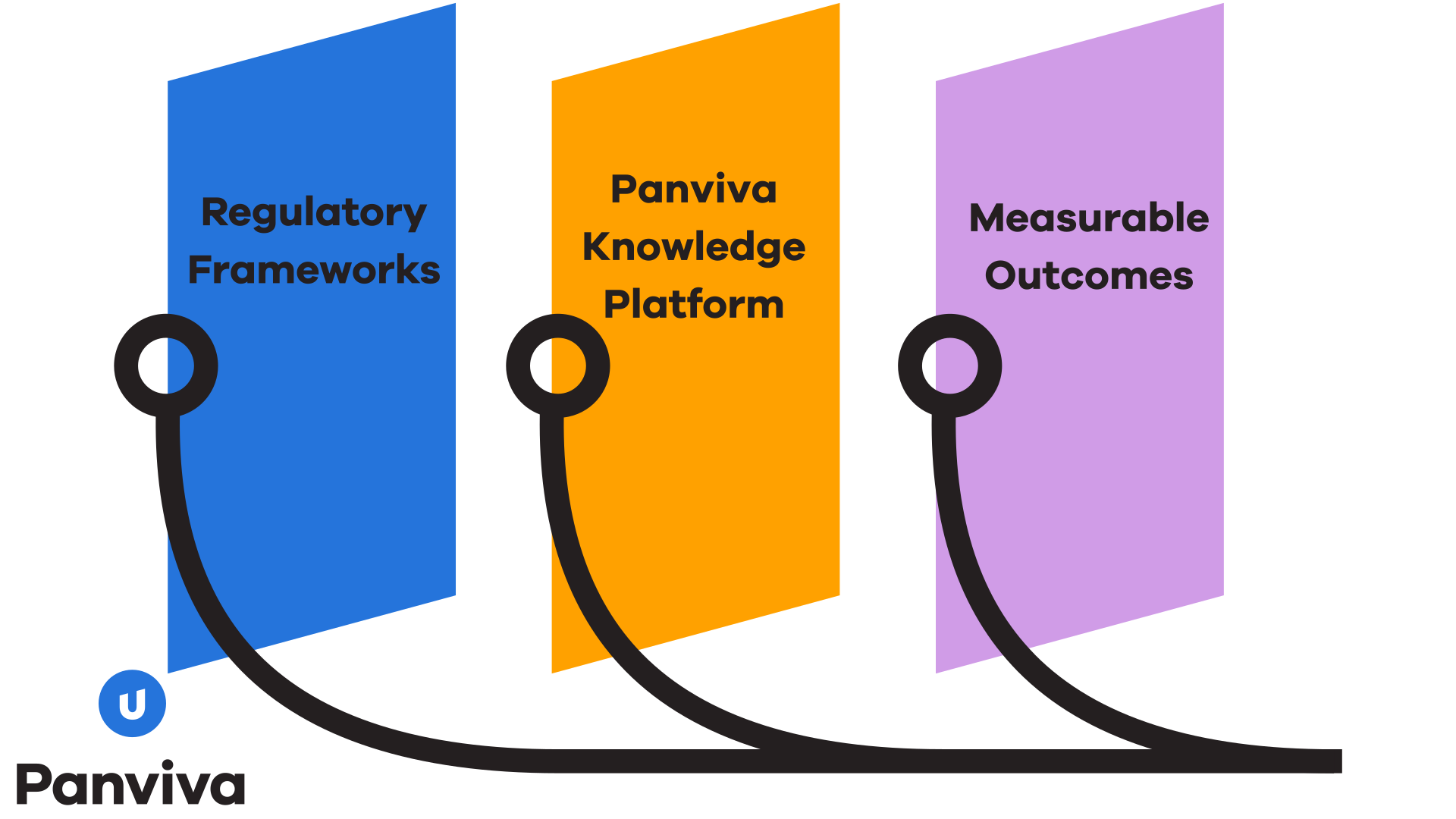
The AI-Powered Compliance Ecosystem: Driving Efficiency in Regulated Contact Centers
Panviva operates as the compliance backbone of the contact center technology stack. Its architecture connects AI-powered knowledge curation, human-expert approval, and real-time agent delivery into a single governed ecosystem.
This approach addresses one of the most persistent challenges in regulated contact centers: knowledge updates rarely reach all agents consistently, creating the inconsistency that regulators treat as a control failure. Panviva solves this by automating update propagation through structured workflows, ensuring every agent operates from the same approved, current source of truth — regardless of channel.
How Have Enterprises Achieved ROI with Compliant Knowledge Management?
Organizations in regulated sectors report measurable returns after deploying Panviva’s compliant knowledge management platform:
- Park National Bank transformed its Customer Care Center using Panviva, centralizing knowledge, improving real-time guidance, and streamlining training. The result was a 32% reduction in agent turnover, faster call resolution, and enhanced compliance in a highly regulated banking environment. Read the Park National Bank case study.
- Nevada Health Centers, a federally qualified health center (FQHC) operating under strict HRSA compliance requirements, deployed Panviva across patient intake, scheduling, and customer service teams. Outcomes included a 75% reduction in training time, a 59% reduction in agent turnover, and a 15% reduction in call abandonment. Read the Nevada Health Centers case study.
- 4Front Credit Union used Panviva to transform the member experience, delivering consistent and compliant guidance across all service channels. Read the 4Front Credit Union case study.
- A leading healthcare provider that adopted a platform with HIPAA-aware controls cut compliance incidents by 30%, strengthening patient trust and lowering remediation costs.
- A financial services firm used AI-powered compliance workflow automation to achieve a 25% increase in operational efficiency alongside fewer regulatory penalties.
These outcomes demonstrate that compliance and productivity gains are not mutually exclusive — with the right platform, they reinforce one another.
What 2026 Trends Are Accelerating Compliance Adoption?
Several forces in 2026 are making compliance-first knowledge management more urgent than ever:
- Widespread AI adoption creates demand for platforms that blend automation with verifiable human oversight — a combination Panviva delivers through its human-in-the-loop AI model.
- Remote and hybrid work models require systems that secure distributed teams without inhibiting collaboration or creating inconsistent knowledge access.
- Increasing regulatory scrutiny across healthcare and financial services is raising the stakes for agent errors, making real-time, auditable guidance essential rather than optional.
- Contact center agent turnover continues to create recurring knowledge gaps. Platforms like Panviva address this directly with structured onboarding, comprehension quizzes, and real-time learning checks that reduce time-to-competency.
Organizations that choose a compliance-first knowledge platform now are building the operational resilience to navigate this environment — and gaining a competitive advantage in the process.
Frequently Asked Questions
What are the key benefits of using compliant knowledge management software?
Compliant knowledge platforms strengthen data protection, simplify regulatory adherence, and make information sharing consistent and auditable. They reduce legal and breach risk, accelerate resolution times, and improve agent confidence — all of which build stakeholder trust and support operational efficiency at scale.
How can organizations ensure ongoing compliance with evolving regulations?
Organizations should adopt a proactive compliance program: keep software current with regulatory changes, run regular audits, and invest in continuous agent training. AI-powered analytics can monitor compliance posture in real time and surface anomalies before they escalate. Embedding compliance into workflows and organizational culture — rather than treating it as a periodic exercise — is the most reliable long-term strategy.
What role does employee training play in knowledge management compliance?
Training is critical and often underestimated. Ongoing, role-specific education helps employees understand their obligations and use knowledge tools correctly. Panviva supports this directly through built-in comprehension quizzes and real-time learning checks, enabling agents to move from novice to competency-ready faster while reinforcing compliant behavior at the point of need.
How do organizations measure the effectiveness of their knowledge management software?
Organizations should track KPIs including user engagement rates, average handle time (AHT), first contact resolution (FCR), compliance incident frequency, and agent satisfaction scores. Pairing quantitative metrics with regular user feedback and audit results uncovers gaps and guides continuous improvement. Panviva’s analytics and reporting suite supports this measurement across all of these dimensions.
What challenges do organizations face when implementing compliant knowledge management software?
Common challenges include resistance to change from frontline staff, difficulty integrating with legacy systems, and translating complex regulatory requirements into enforceable technical controls. Successful implementation depends on stakeholder alignment, clear governance structures, targeted training, and choosing a platform that is both configurable and easy to adopt. Panviva’s 23 years of contact center KM experience directly addresses these implementation risks.
Is Panviva suitable for small and mid-sized organizations in regulated industries?
Panviva is designed for mid-market to enterprise organizations with 500 or more employees, typically operating contact centers with 100 to 300 user seats (with options starting from 25 seats). Organizations that manage complex regulatory obligations, high contact volumes, or distributed frontline workforces — regardless of whether they are large enterprises or growing mid-market firms — can benefit from Panviva’s compliance-first architecture.
How does Panviva compare to other knowledge management platforms on compliance?
Most knowledge management platforms treat compliance as a feature set. Panviva treats it as a foundational design principle. Unlike competitors such as Salesforce Knowledge — which lacks the same omnichannel governance capability and requires costly IT customization — or livepro, whose compliance controls are limited to approved language only, Panviva provides end-to-end governed knowledge delivery with AI-powered curation, human-expert approval, workflow automation, and full audit trails built in from the ground up.