6 Hidden Challenges of Knowledge Management in Healthcare Contact Centers
6 Hidden Challenges of Knowledge Management in Healthcare Contact Centers
7 minute read



Contact center challenges are well documented and include robust agent training needs, operational costs, and frequent policy change. But contact centers in the healthcare industry must contend with added complexity.
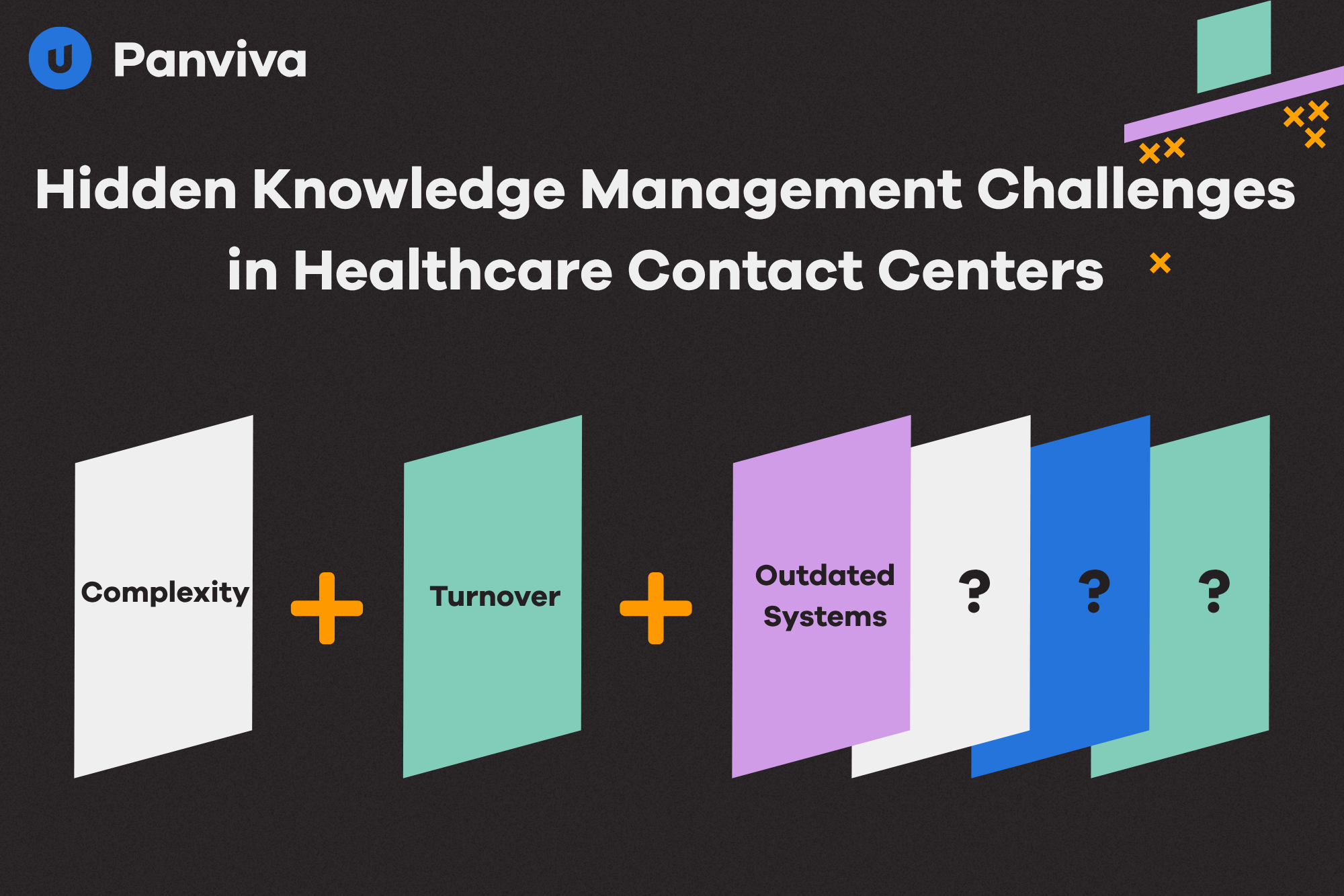
Due to regulatory obligation, clinical complexity, compliance risk, and more—the typical operational gaps of healthcare contact centers are often amplified further by the nature of the healthcare industry itself.
Here are 6 hidden pressures facing knowledge management in healthcare contact centers and how to address them directly in your knowledge management system.
1. Regulatory compliance and complexity in healthcare knowledge management
Healthcare contact centers inherently must navigate HIPAA, CMS standards, and HRSA requirements—not to mention ever-changing, state-specific mandates. And because none of these considerations stand still over time, there are a near-infinite number of changes to anticipate when building a healthcare knowledge management system.
The takeaway: If your knowledge isn’t static, neither should your knowledge management system. Invest in healthcare contact center software that’s built to scale, change, and adapt alongside your contact center.
2. Agent turnover and the erosion of institutional knowledge management systems in healthcare
High rates of agent turnover is another challenge that’s typical among contact centers but heightened in healthcare. With annual attrition rates reaching heights of up to 57% in healthcare contact centers, compared to around 25-30% among other industries, it’s safe to say that the industry plays a role.
Why? Certainly, the complexities detailed above are part of the reason. Healthcare contact center agent turnover can also be traced to poor or dwindling knowledge management resources. This is compounded every time an agent departs because when an agent leaves, their institutional knowledge leaves with them.
The takeaway: Unhappy healthcare contact center agents are overworked healthcare contact center agents. When Park National Bank decreased their agents’ cognitive load with in-workflow guidance from Panviva, they saw a near-60% reduction in turnover. View the case study.
3. Scattered sources of truth and outdated systems
Ask a healthcare contact center agent where to find the current policy on prior authorization requests, and they may go straight to a shared drive folder. Ask another, and they’ll turn to an outdated PowerPoint slide. A third may rely solely on the first two! This is knowledge fragmentation—and it’s common in healthcare contact centers that have accumulated knowledge management reference content without consolidating it into a governed, single source of truth.
The takeaway: AI-powered conversational search changes this dynamic. Instead of requiring agents to know where to look, it simply displays correct, governed information in natural language directly in the flow of work. Panviva’s Sidekick’s AI conversational search was built as an answer to this problem in healthcare knowledge management. Learn more about Panviva Sidekick.
4. Balancing compliance and customer service needs with performance and efficiency goals
In healthcare contact centers, there’s often a disconnect between the need to stay compliant and the pressure to hit certain performance metrics. But aggressive KPIs like call handling time targets, abandon rate benchmarks, and first-call resolution goals don’t leave a lot of room for compliance considerations.
Plus, using AI to search for answers increases the risk of sharing wrong information. That’s because an AI assistant trained on outdated or inconsistently maintained knowledge will magnify and spread ALL content—even inaccurate information.
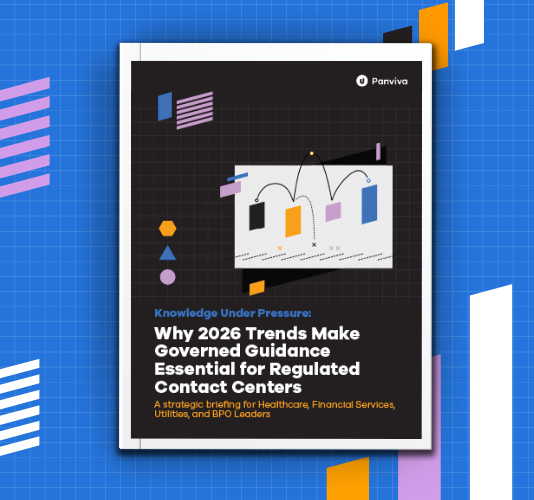
The takeaway: This is the core argument made in the Knowledge Under Pressure Mini eBook Part 1: Why Regulated Contact Centers Must Prioritize Governed Infrastructure. Before healthcare organizations can safely benefit from AI, they need to first build and fortify a compliance-first knowledge foundation with clear SME ownership, structured content controls, and approval workflows that ensure accuracy every time.
5. The need for ongoing healthcare knowledge management training for agents
Traditional classroom-based training approaches struggle to efficiently deliver the nuanced information healthcare contact center agents need to be successful. On the other hand, agents relying on individual memorization alone are also prone to errors due to the sheer amount of information to memorize.
Nevada Health Centers demonstrates what a modern healthcare knowledge management approach looks like. By implementing Panviva to give agents access to accurate, up-to-date information directly in the flow of their work, the organization achieved a 75% reduction in training time. Agents no longer needed to memorize every process. Instead, they were guided through complex interactions with contextual, step-by-step knowledge—reducing time-to-competency and freeing training resources for higher-value development.
The takeaway: agents can serve customers faster and understand relevant information more easily with ongoing, guide-on-the-side knowledge delivery.
6. Maintaining a customer service presence across channels
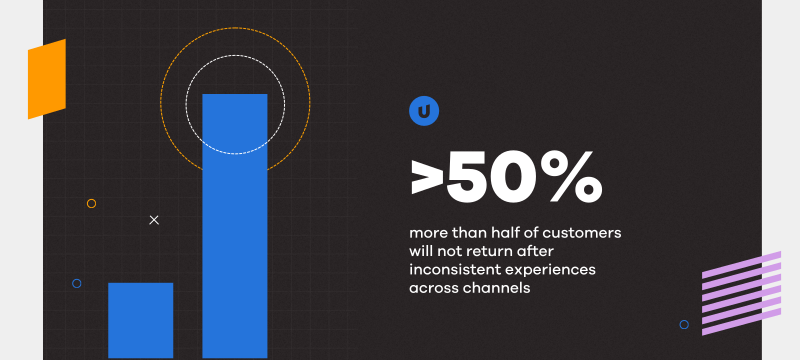
Members expect to move seamlessly between phone, chat, self-service portals, and digital channels—receiving the same information regardless of who they’re speaking to.
Each team does its best, but over time the result is what Martin Hill-Wilson describes in Knowledge Under Pressure Mini eBook Part 4: Omnichannel Consistency: Delivering Unified Customer Experiences as version drift: four different truths living in four different systems.
In healthcare, this drift is both a customer service issue and a compliance risk. When a patient reads an eligibility statement on your website, for example, then confirms it via chatbot, and is told something different by an agent, the organization has delivered conflicting guidance.
The takeaway: a single source of truth is no longer a nice-to-have. When a regulation changes, an update to the source propagates everywhere, and closes the window for inconsistency.
Frequently Asked Questions
What’s the best contact center software for healthcare?
The best contact center software for healthcare is one that goes beyond routing and scheduling to address the knowledge and compliance challenges unique to the industry. Look for platforms that offer governed knowledge management, real-time agent guidance, HIPAA-aligned audit capabilities, and consistency across customer service channels. Panviva is purpose-built for regulated industries, including healthcare, and integrates with a range of applications to provide up-to-date guidance.
What is the most compliant knowledge management software for healthcare?
Compliant knowledge management software for healthcare needs to support HIPAA requirements, including role-based access controls, detailed audit trails, and structured approval workflows that govern content before it reaches agents or patients. Panviva’s compliance-first architecture is designed specifically for this environment— ensuring every answer delivered has first been governed exclusively by your organization.
How do I improve onboarding for contact center agents in healthcare?
The most effective way to improve onboarding in healthcare contact centers is to shift away from memorization-based training toward real-time knowledge management. When agents can retrieve accurate, guided information in the flow of their work rather than recall it from memory, ramp time drops significantly.
What are some compliance requirements unique to healthcare knowledge management?
Healthcare contact centers operate under a distinct set of compliance requirements. HIPAA mandates strict protections for protected health information, while CMS sets quarterly performance benchmarks. Then, organizations receiving federal funding—such as FQHCs operating under HRSA—face additional federal oversight requirements. Each of these obligations places direct demands on a healthcare contact center’s knowledge infrastructure.
Why is agent turnover so high for healthcare contact centers?
Healthcare contact center agents navigate clinical terminology, complex payer policies, strict compliance requirements, and emotionally sensitive patient interactions—often simultaneously. Without the right tools to support them, the cognitive load is significant. Agents who lack access to clear, up-to-date information are more likely to feel unsupported, make errors, and ultimately burn out. High attrition is often less related to compensation and culture and more related to knowledge infrastructure.
Conclusion
Healthcare contact centers face pressures that don’t disappear with a single technology investment. They require deliberate strategy, governed infrastructure, and tools built for the complexity of a regulated environment.
Discover Panviva for yourself with our interactive, self-led demo!