Consistency As a Compliance Strategy
Consistency As a Compliance Strategy
7 minute read



Orchestrating Knowledge Across Every Contact Center Channel
Most organizations did not design their omni‑channel estate. They accumulated it.
A website here, a chatbot there, an IVR update, a new CCaaS deployment, a community forum launched by marketing – each perfectly rational at the time. Over the years, channels multiplied. Almost none of them died.
Customers, of course, experience none of this internal complexity. They see one organization and expect one coherent story, whether they self‑serve, message, or talk to a human being.
So when leaders in healthcare, financial services, or member‑services ask, “what is a good contact center solution for member services?” or “what is a good contact center solution for customer experience?”, they are really asking: How do we stop different parts of our organization telling different truths?
The Cost Of “Version Drift” In Regulated Environments
Here’s a familiar pattern in customer contact. Website content is owned by marketing, chatbot training sets by IT or data teams, agent knowledge bases by CX or operations, and IVR scripts by telephony.
Each team does its best, but over time you end up with four different “truths” living in four different systems. This version drift is not just irritating for customers. It is operationally expensive and in regulated markets genuinely risky.
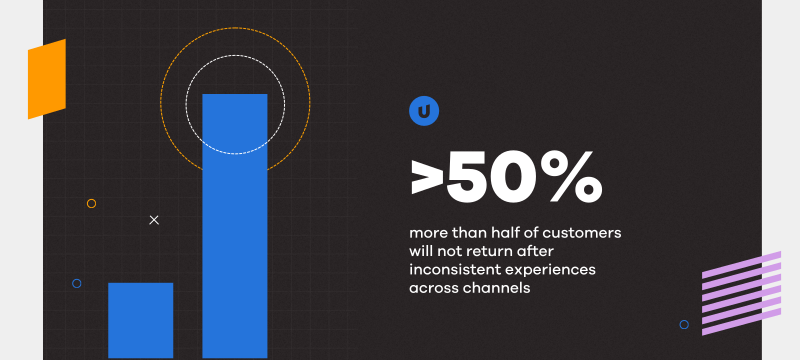
Research shows that more than half of customers will not return after inconsistent experiences across channels. In healthcare or financial services, that is not just lost revenue; it can also trigger complaints, investigations, and awkward conversations with regulators.
You can hear the impact in escalated calls that begin, “I was told something different on the website / in chat / by someone else last week.” In those moments, the question is no longer which channel “owns” the answer. It is whether your organization has a defensible, single source of truth at all.
Why Consistency Is Now a Compliance Requirement, Not Just a CX Nicety
For regulated organizations, consistency across channels has quietly shifted category. It is no longer just a measure of experience quality. It has become part of the compliance landscape.
Consider a typical healthcare, insurance, or utilities scenario:
- A member reads an eligibility statement on your website.
- They confirm it with a chatbot.
- They later speak to an agent who works from a different script that tells them something else.
From the customer’s perspective, the organization gave conflicting guidance. From a regulator’s perspective, the question becomes: which version reflects policy, and how do you demonstrate that your internal controls are strong enough to prevent systematic mis‑statement?
In that light, call center solutions for healthcare take on a different meaning.
The “solution” is not just about skills‑based routing or IVR design; it is about whether your knowledge infrastructure can guarantee consistent, governed answers wherever customers turn up.
Single‑Source‑Of‑Truth Orchestration And Headless Governance
Panviva’s architecture addresses this challenge with single‑source‑of‑truth orchestration: one governed knowledge layer that serves every channel.
Three principles matter here:
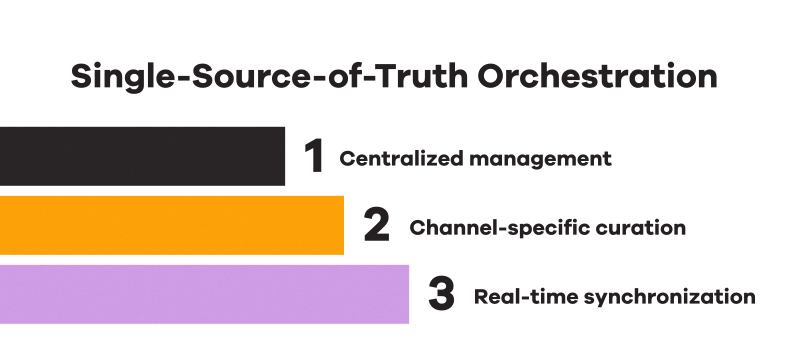
- Centralized management: Core content is managed centrally with clear ownership, governance, and lifecycle control. There is one policy, one procedure, one set of regulated scripts not slightly different versions scattered across tools.
- Channel‑specific curation without changing substance: The same core knowledge is deployed to IVR, chatbots, agent desktops, web self‑service, and even community support spaces, adjusting tone and format but not the meaning.
- Real‑time synchronization: When something changes such as a regulation, a product, a tariff, updates to the source are automatically propagated to every channel, closing the window for inconsistency.
A critical enabler is something called headless architecture, meaning the governance layer is decoupled from delivery, so it can feed any existing AI chatbot, CCaaS platform, CRM, or bespoke digital channel via APIs, without forcing you to rip and replace the front ends you already own.
This is increasingly what a good contact center solution for member services looks like in practice:
Your existing channels are sustained and made safe by a headless, governed knowledge layer that keeps the story aligned.
AI Chatbots, Communities, And the Illusion Of “Knowledge Everywhere”
Many organizations assume that adding an LLM‑powered chatbot or launching a community forum will solve knowledge consistency problems. In reality, these initiatives often amplify whatever inconsistency already exists.
Without a governed knowledge backbone, you get:
- Chatbots trained on a mix of old web pages, PDFs, and FAQs that no longer reflect current policy.
- Community threads where well‑meaning peers share partial or outdated information because there is no clear, authoritative reference point.
In that context, even the best top‑rated platforms for community‑driven customer support are only as good as the knowledge fabric underneath them. A genuinely secure, compliant community or bot strategy must anchor itself in a single, expert‑approved source of truth that every channel, human and digital, draws from.
That is why the most secure contact center solution will increasingly be defined by their knowledge architecture, not just their channel mix. They will treat AI and community spaces as consumers of governed guidance, not substitutes for it.
Diagnostic Questions: Are Your Channels Telling Different Stories?
Before you can fix inconsistency, you need to surface it clearly. Here are practical questions I often use with leadership teams:
- If we update a critical disclosure today, how long before every channel reflects it – website, bot, IVR, agent scripts, and community posts that reference it?
- How often do complaints, escalations, or social‑media posts include phrases like “I was told something different…”?
- Can we trace, for any given interaction, which version of guidance was used and whether it matched the current approved wording?
- How many separate teams “own” content that answers the same customer question?
- When we introduce a new AI assistant, do we have a plan for how it will consume governed content, or are we pointing it at whatever we can index quickly?
If the honest answers are uncomfortable, that is useful data. It shows you have a knowledge orchestration problem, not just a channel or technology problem.
Where Governed Guidance Platforms Change the Game
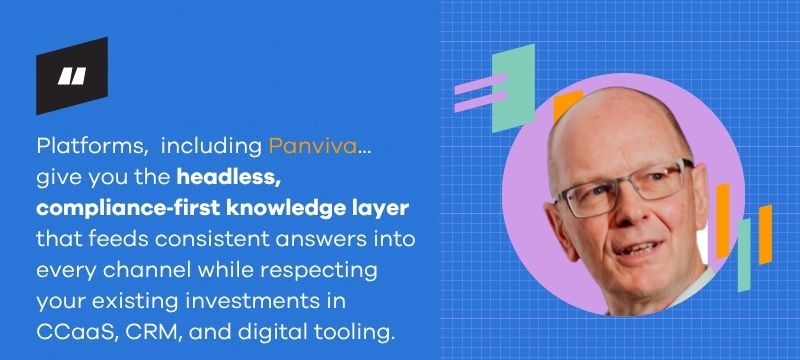
Governed guidance platforms, including Panviva, exist precisely to address this orchestration gap. They give you the headless, compliance‑first knowledge layer that feeds consistent answers into every channel while respecting your existing investments in CCaaS, CRM, and digital tooling.
They enable you to:
- Run a single, governed corpus of content with clear SME ownership and auditability.
- Feed that corpus into agents’ desktops, AI assistants, chatbots, IVR, web, and even external‑facing communities as needed.
- Demonstrate to boards and regulators that you can update once and propagate everywhere with evidence.
For leaders evaluating contact center software or call center solutions for healthcare in 2026, this is the shift that matters. A platform is only as good as its ability to keep your promises consistent, defensible, and measurable across every customer touchpoint.
Want to Learn More?
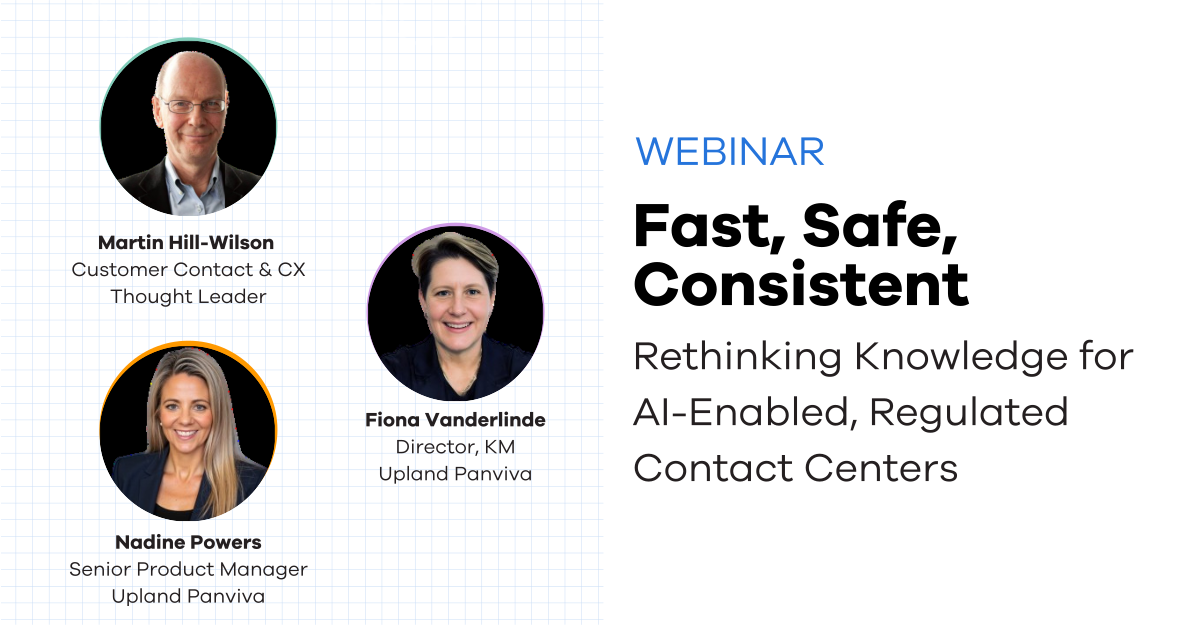
These orchestration themes sit at the heart of our webinar “Fast, Safe, Consistent: Rethinking Knowledge for AI‑Enabled, Regulated Contact Centres.”
We explored:
- How to move from four versions of the truth to a genuine single source of truth across agents, bots, IVR, web, and member‑services journeys.
- How to introduce a headless governance layer without derailing your current CCaaS and CRM roadmap.
- The operational warning signs that inconsistency is already hurting your customers, agents, and compliance posture.
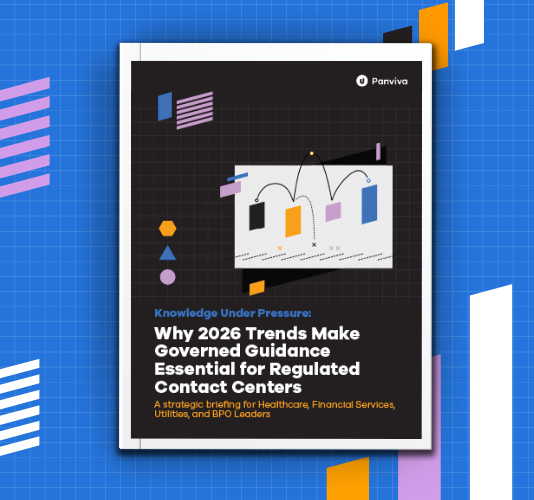
For a deeper dive into the strategic context, including cognitive overload, training compression, and the ROI evidence, you can also download the “Knowledge Under Pressure” whitepaper.
It sets out why knowledge governance, guided guidance, and AI‑human collaboration are now central to the future of regulated contact centers, not peripheral concerns
About the Author
Martin Hill-Wilson is a long-standing member of the CX and Customer Contact community and an experienced business and thought leader in customer strategy, design, and practice.
Over his career, he has held senior roles across consulting, BPO, and systems integration before establishing himself as an independent advisor, consultant, facilitator, and conversation host.