Why Trusted Knowledge Matters More than Content
Why Trusted Knowledge Matters More than Content



Top line
Top line
How knowledge management and governance prepare people and AI for better answers.
Modern organisations already have more information than they can comfortably manage.
Business systems create documents, articles, policies, procedures, records, messages, training material and AI-generated content as part of everyday work. Each system may be useful in its own context. Collectively, however, they create a difficult question:
Which information is current, approved, relevant to this person’s task, and safe to use as an operational answer?
This question matters for employees, contact-centre agents, customers and, increasingly, AI assistants. That’s because knowledge management for AI is not primarily a technology challenge. It is the discipline of maintaining current, approved and usable knowledge that people and AI assistants can trust.
Why knowledge management for AI starts with governance
This problem existed long before AI assistants, and long before today’s document repositories.
Libraries solved a version of it through classification systems, supported by librarians who maintained the catalogue, applied consistent rules and helped people locate the right material. Filing cabinets relied on labels, folders and people who understood, and maintained, the filing system.
Knowledge management has the same underlying requirement: information becomes usable when someone owns the structure, the standards and the upkeep around it.
Many document repositories, however, were designed primarily to store and publish content. They rarely receive the same dedicated stewardship. A team may know exactly where its documents sit and which version to use, until a restructure, system migration or staff change disrupts that shared understanding. Then the practical question returns: ‘Where’s that thing I need, and can I trust it?’
Technology isn’t usually the biggest problem. The harder problem is the assumption that more technology should require less maintenance. With AI, that assumption can become more tempting: connect everything, index everything and let the system try to resolve the inconsistencies people didn’t have the time for.
But AI cannot determine which policy is current, which procedure is approved, or which of two conflicting documents represents the organisation’s approved way of working. Yes, it is faster at searching, retrieving and producing a plausible response. However, it can also sound highly confident when its outputs are incomplete, outdated or ungoverned, making mistakes easier to miss.
The issue is not whether AI can find information. It is whether the organisation has maintained the knowledge needed to give people and AI a trustworthy answer.
Every business system creates content
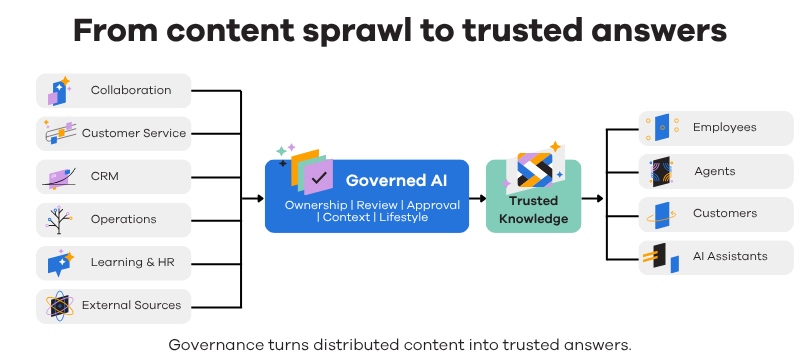
Collaboration platforms create and store documents and team information. Customer-service platforms create and store articles and scripts. CRM, learning, HR, operational, project, and ticketing systems all capture and store information that may later be needed.
These systems are not the problem. They are solving real business needs. Issues appear when an answer crosses systems, audiences or business processes.
Content can be duplicated. Ownership can become unclear. Review practices can vary. Different audiences can receive different versions of what should be the same guidance.
People use familiar survival strategies. They ask a colleague. They check an old message. They copy from a previous ticket. They rely on personal experience or keep their own local document because it feels safer than trusting a search result.
The organisation may have many places where information exists without having a dependable way to deliver trusted knowledge.
A document repository is not a knowledge-management strategy
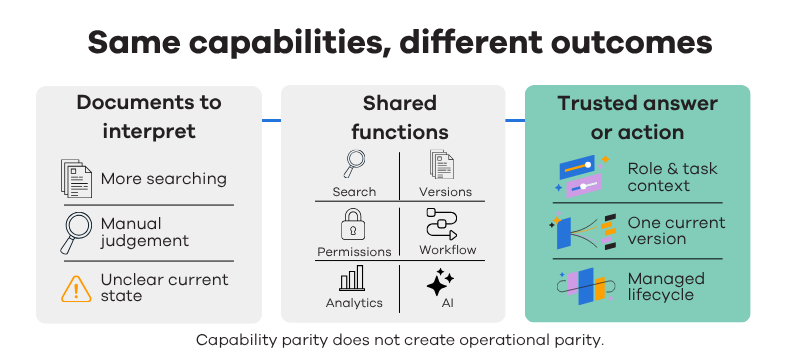
Most enterprise platforms now provide search, version history, permissions, metadata, workflow, analytics and AI integration.
This has created the impression that a document repository and dedicated knowledge-management capability are interchangeable. On a feature checklist, they may look similar.
The more important question is what happens after a feature is enabled.
Search may return a long list of documents that someone must open, scan and search through again. Or it may produce a concise, AI-generated summary without making clear which sources were used, whether they are current and approved, or how much confidence the user should place in the response.
Permissions can be configured to restrict or grant access. But how often are they reviewed as teams, projects and responsibilities change? How confidently can the organisation say the right people still have access to the right knowledge?
Approval may happen once, while nobody returns to review the content or ensure it remains aligned with regular operational, policy or regulatory change.
The challenge is not simply enabling a feature. It is maintaining the operating discipline that keeps their outcomes reliable over time.
Version history can exist without creating confidence
Most people have seen this familiar pattern before:
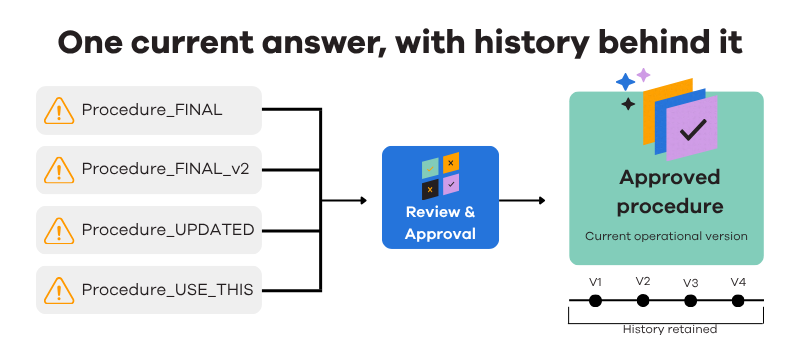
- Procedure_FINAL.docx
- Procedure_FINAL_v2.docx
- Procedure_FINAL_UPDATED.docx
- Procedure_FINAL_UPDATED_USE_THIS.docx
This isn’t a software defect. It is a trust and governance issue.
Version history may preserve every edit, but users still create copies when they do not trust the process that should identify the current version. They keep local workarounds, send attachments to colleagues and ask around for confirmation.
The target is not to delete history. It is to give people and AI one current, approved operational version, with the history and evidence behind it.
A useful question for any priority procedure is simple: ‘How would you prove which version is approved today?’
A document is not the same as usable knowledge
Trusted knowledge is not simply a document with more metadata. It is information deliberately designed for a purpose, audience, task and delivery channel.
An employee looking up a policy may need context and rationale. An agent handling a live customer call may need a short action path, a decision table, approved language and a link to supporting resources. A customer may need plain language and a safe escalation path.
A practical knowledge-management approach distinguishes between reusable types of knowledge, such as:
- procedures that explain how to perform a task;
- concepts that explain what something is or why it works that way;
- reference information containing facts, values or definitions;
- decision tables that guide a choice under defined conditions;
- approved scripts; and
- soft-skills guidance for tone, empathy or interaction.
This does not mean every organisation needs a complex new technical model. It means the information used to support work should be shaped for that work.
The objective is not to help people find more information. It is to reduce the mental load caused by finding, interpretation and recall required to complete a task correctly.
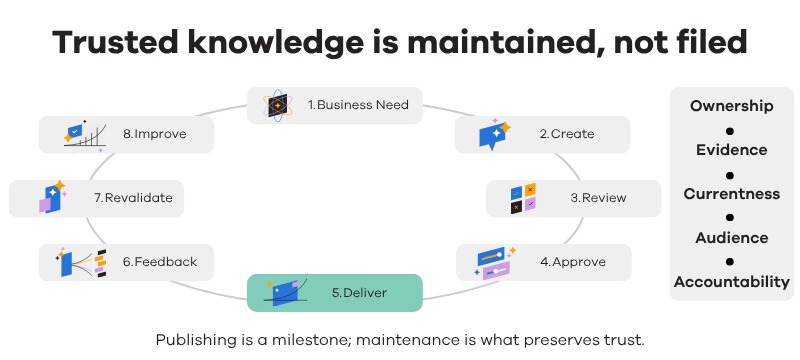
Trusted knowledge is maintained, not filed
Knowledge becomes trustworthy through a knowledge governance lifecycle, not through a single publication event.
It begins with a business need. Knowledge is created or brought in from an approved source, reviewed by an appropriate expert, approved, delivered to the right audience and measured through usage and feedback.
It is then revalidated, improved, replaced or retired as the business changes.
Governed knowledge means there is a named owner, a clear review and approval process, a current-version decision, an appropriate audience and a way to respond when the source, policy or process changes.
Approval is a decision at a point in time. Trust requires ongoing responsibility.
Ingestion is not publication
Most organisations already have many large bodies of content. They do not need to rewrite everything before improving a single important journey.
A governed ingestion approach selects content relevant to a defined need, records where it came from and who has authority over it, preserves a source copy for reference, structures it for the intended use, and sends it through human review and approval before publication.
This creates a deliberate boundary between content that exists and knowledge the organisation is prepared to stand behind.
AI can assist with classification, restructuring, decision-table construction and style checking. But AI assistance is not approval. Before transformed content is used to guide employees, customers or an AI assistant, an accountable subject-matter expert must confirm that it accurately reflects the source, preserves required actions and complies with relevant policy or regulation. Until that review is complete, it remains a draft, not trusted operational knowledge
Can you show where an answer came from?
Trust is not only a quality judgement. It is the ability to show how the current knowledge came to be.
For important knowledge, an organisation should be able to identify the source version, when it was captured, how it was changed, who reviewed it, who approved it, which version was published and how it was delivered.
This is traceability: the ability to reconstruct the path from source to current answer when it matters.
For AI-supported answers, traceability should extend to the approved knowledge versions used and the audience or access context in which the answer was produced. Not every technical event needs to appear in front of the user, but the organisation should be able to investigate an answer if it is challenged.
Building AI-ready knowledge management
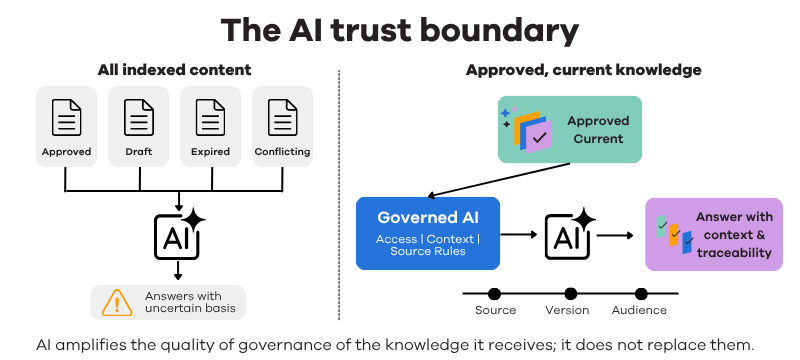
AI can retrieve, summarise and deliver knowledge at a scale and speed that makes weak governance more consequential.
If multiple systems contain conflicting procedures, expired content, drafts and unowned documents, AI has no way to know which item reflects the approved way of working. It may even produce a plausible response from information that should never have been used together.
This is why more indexed content does not create better answers. Better governance creates better answers.
AI should be treated as a consumer, assistant or transformation participant, never as the owner of organisational knowledge.
A controlled approach to AI includes clear boundaries around what knowledge it may use, current-version rules, audience and access controls, source references, correction loops and human accountability for high-consequence content.
Organisations do not need to transform every knowledge domain at once. A simple four-stage maturity model helps establish a shared starting point:
Scattered → Collected → Controlled → AI-ready
Scattered means people rely on memory, informal networks and individual judgement.
Collected means a knowledge base exists, but content may still be inconsistent, stale, duplicated or untrusted.
Controlled means priority knowledge has owners, review dates, approval status, change history and defined boundaries for use. This is the minimum viable foundation for a controlled AI pilot in a regulated or high-consequence environment.
AI-ready means knowledge is actively tested, measured, improved and traceable across appropriate channels. It does not mean every item is perfect. It means the organisation can detect, investigate and correct problems before they distribute at the speed of AI.
Conclusion
Organisations do not become AI-ready by connecting more content.
They become AI-ready by knowing which knowledge to trust, how it is maintained and how an answer can be traced back to its source.
Existing business systems remain important. They create and manage operational content in the context of their own work. A knowledge-management capability adds the discipline to select, structure, maintain, trace and deliver the knowledge that people and AI can responsibly use.
The result is not another document library. It is a managed supply of trusted knowledge for operational work.
Learn more
Trusted knowledge does not require an enterprise-wide transformation before value can be demonstrated. It begins with understanding one important journey, the knowledge that supports it and the controls needed to make its answers reliable.
To explore how a governed knowledge-management approach can prepare your people and AI for better answers, contact us to speak with our team.